Frank has not attended a scheduled activity in three weeks. His name does not appear on a single sign-in sheet. If the community's engagement report pulled data from the activity calendar alone, Frank would show up as disengaged, at risk, possibly declining.
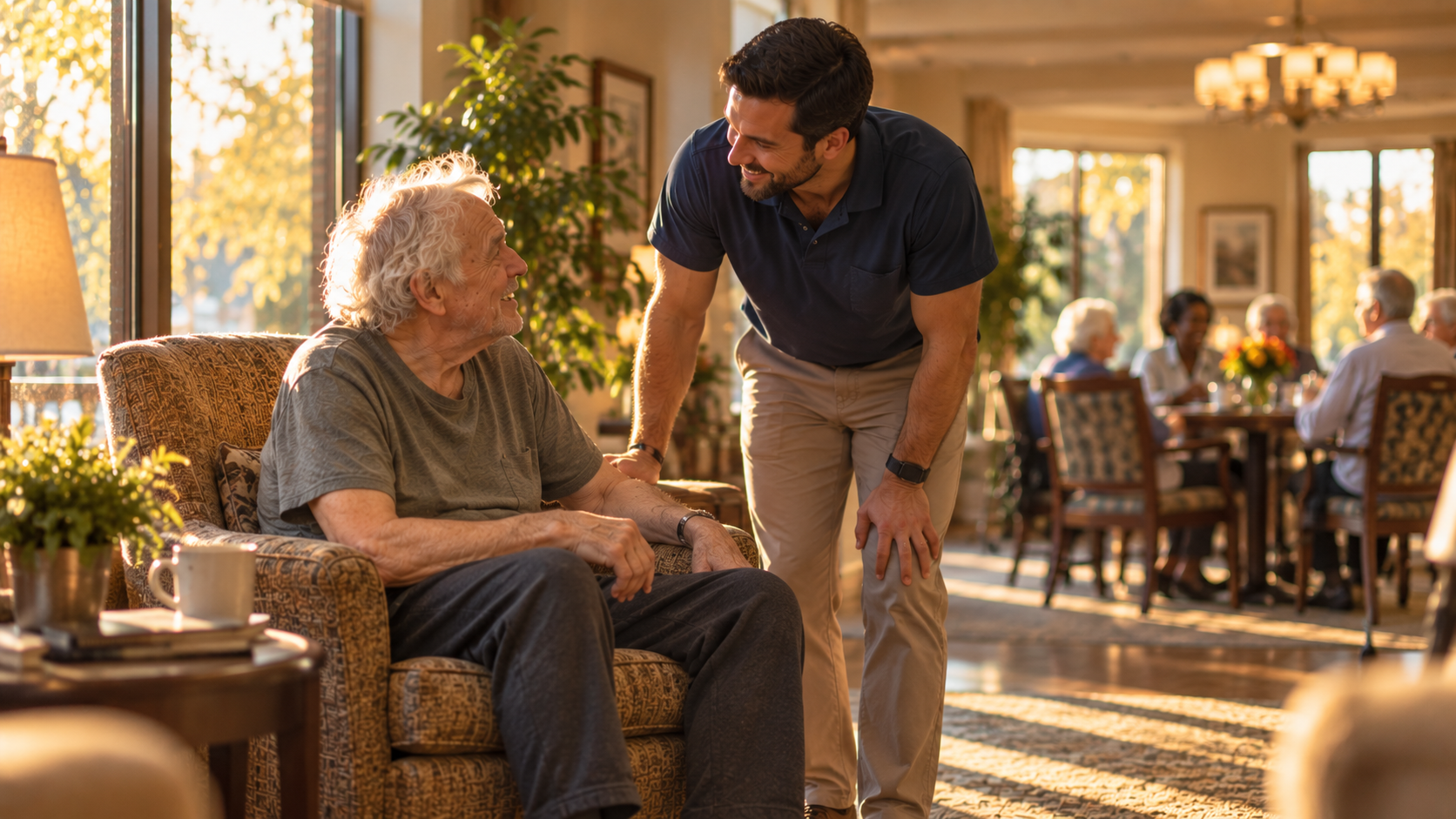
But Frank is not disengaged. He eats breakfast in the dining room every morning at 7:15, twenty minutes before the rush, and sits with the same two men he met during his first week. They talk about the news, complain about the coffee, and occasionally argue about baseball. After breakfast, Frank walks the garden path. He does this alone, and he prefers it that way. By 10:00, he is in the library reading a biography. He reads one a week. Around 2:00, his daughter calls. They talk for forty minutes. He tells her about the book. She tells him about the grandkids. At 4:00, he sits in the lobby and watches people come and go. A CNA named Darren always stops to talk to him. They have a running conversation about fishing that has been going on for months.
Frank is deeply connected to this community. He has relationships, routines, and a daily rhythm that gives him purpose and belonging. None of it is captured. None of it counts. Because none of it happened during a program.
Senior living has always measured participation through the activity calendar. A resident attended the music program. She came to bingo. He signed up for the cooking demo. These are the data points that go into reports, get shared with families, and satisfy regulatory documentation. They matter.
But they are not the whole picture. Not even close.
When communities define participation as "showed up to a scheduled activity," they build their entire understanding of resident engagement around one narrow channel. They see the residents who attend programs and miss the residents who participate in community life through every other channel available to them. Dining room conversations. Hallway interactions. Self-directed routines. Relationships with staff. Phone calls with family. Walks, reading, gardening, worship, and the hundred small moments that make a person feel like they belong somewhere.
These are not lesser forms of engagement. For some residents, they are the primary forms. And when a community cannot see them, it cannot protect them. It cannot notice when they change. It cannot respond when they stop.
The activity calendar exists for good reasons. It provides structure, variety, and opportunities for social connection. Life enrichment professionals pour enormous effort into building programming that serves their residents, and the best programming is genuinely person-centered, designed around who is in the building.
But the calendar is a tool for the life enrichment team. It is not a complete picture of how residents engage with their community. And when participation is tracked exclusively through the calendar, two things happen that quietly distort a community's understanding of its residents.
First, residents who do not attend scheduled programming get classified as disengaged. Frank is the clearest example. His daily life is rich with connection, routine, and purpose. But because none of it is associated with a program on the calendar, the system has nothing to report. In a community that tracks participation only through programming, Frank is a problem to solve. In a community that tracks participation broadly, Frank is a resident who is thriving.
Second, residents who attend programming regularly can mask real engagement problems. A resident who shows up to every bingo game but sits silently in the back, never interacts with the people around her, and leaves the moment the last number is called has a participation pattern that looks strong on paper. She attended. She was present. But was she engaged? Was she connecting? Was she getting anything from the experience beyond filling an hour? The sign-in sheet says yes. The truth may be very different.
Both of these distortions point to the same underlying issue: when the only lens for participation is the activity calendar, the system measures what is easy to count rather than what matters.
If participation is going to serve as a meaningful Resident Engagement Intelligence signal, it needs to encompass the full scope of how a resident engages with community life. Not just the scheduled events, but everything.
Dining engagement is one of the richest and most overlooked sources of participation data. Meals are the most consistent daily touchpoint in any community. Every resident eats. Where they sit, who they sit with, whether they initiate conversation, whether they eat alone by choice or by circumstance: these patterns reveal things about social connection and emotional wellbeing that no activity report captures. A resident who used to eat with friends and now asks for meals in her room has told the community something important. If nobody is tracking that pattern, nobody responds.
Informal social interactions between residents, and between residents and staff, are participation. The hallway conversation that lasts ten minutes. The CNA who always stops to talk about fishing. The volunteer who reads to a resident every Tuesday. These interactions are often the most meaningful connections a resident has, and they happen entirely outside the calendar.
Self-directed activities count. A resident who reads every morning is engaged. A resident who tends a garden plot is engaged. A resident who writes letters to her grandchildren every Sunday is engaged. These routines reveal identity, purpose, and cognitive investment. They are the Life Story signal in action: participation shaped by who a person is and what has always mattered to them.
Family engagement is participation. A daughter who visits every Saturday and takes her mother for a walk is contributing to that resident's engagement in ways the community should see and support. A phone call, a video chat, a card in the mail: these are connections that sustain residents between programs, and they are especially important for residents who do not attend group activities.
Spiritual and reflective engagement matters. A resident who attends chapel every Sunday, prays in her room each evening, or meditates in the garden is participating in something deeply personal and sustaining. Not every meaningful engagement is social. Not every meaningful engagement is scheduled.
The common thread is that participation, understood fully, is a picture of how a resident lives in community. Programming is one piece of that picture. But it is only one piece.
The reason to expand the definition of participation is not philosophical. It is practical, and it has direct implications for how communities care for their residents.
When participation is defined narrowly, the only interventions available are programming interventions. A resident is disengaged? Invite her to more activities. Offer new programs. Try different formats. These are valid responses when the problem is actually a programming problem. But sometimes the problem is not programming at all. Sometimes the problem is that a resident lost her dining companion. Or that a staff member she had a relationship with left the community. Or that her daughter's visits became less frequent. Or that a physical change made it harder for her to walk to the garden.
None of these are problems that a new art class will solve. They are participation problems that live outside the calendar, and they require responses that live outside the calendar too. A one-on-one conversation with a staff member. A seating change in the dining room. A call to a family member. A walking companion. These are engagement interventions, and they are some of the most important work life enrichment professionals do. But they are invisible in any system that only counts scheduled programming.
Alisa Tagg, a nationally recognized expert in life enrichment and behavioral health, wrote in a recent article "The Power of Connection" that life enrichment professionals are "relationship builders, advocates, listeners, communicators, and connectors" whose role "extends beyond planning calendars and coordinating activities." That description captures precisely what broad participation tracking makes visible: not just the programming a professional delivers, but the connections she facilitates, the patterns she observes, and the interventions she designs around what she learns.
When a community tracks participation broadly, the care team gains a fundamentally different picture of each resident. They can see that Frank is thriving even though he does not attend programs. They can see that the bingo regular in the back row is not connecting with anyone. They can see that a resident's dining patterns changed the week after her roommate moved to memory care. These are engagement signals. They are the Participation signal working alongside Social, Mood, Life Story, Life Events, and Behavioral signals to build the complete picture that Resident Engagement Intelligence is designed to provide.
None of this is news to the people doing the work. Life enrichment professionals have always known that engagement is bigger than the calendar. They see it every day. They know which residents are deeply connected through channels that never appear on a report. They know which residents attend every program but remain emotionally isolated. They carry this knowledge the same way they carry everything else: in their heads, informally, without a system to make it visible to anyone else.
The challenge has never been awareness. It has been infrastructure. How do you track a hallway conversation? How do you document a dining room observation? How do you capture the fact that a resident's daughter called less often this month? These are not data points that fit neatly into an activity attendance log. They require a different kind of system, one designed to see participation as a dimension of care rather than a line item on a programming report.
This is the distinction between activity tracking and engagement intelligence. Activity tracking counts events. Engagement intelligence sees people. And people do not live their lives inside a programming calendar. They live them across every interaction, relationship, routine, and moment that gives their day meaning.
The communities that understand this are the ones that will see their residents most clearly. Not just who showed up to the afternoon concert, but who is connected, who is withdrawing, who is finding purpose in ways the calendar never captured, and who needs someone to notice that something has changed.
Frank finishes his walk, returns his biography to the library shelf, and settles into his chair in the lobby. Darren the CNA passes by, pauses, and says something about a fishing trip he took over the weekend. Frank leans forward. He has questions. The conversation lasts eight minutes.
It is the best part of his day. Nobody documents it. Nobody tracks it. If Frank ever stops showing up in the lobby at 4:00, nobody will see the pattern break, because nobody built a system that saw the pattern in the first place.
That is the cost of defining participation through the activity calendar alone. Not that the calendar is wrong, but that it is incomplete. And every form of engagement it does not see is a form of care it cannot protect.
Participation is more than programming. It always has been. The question is whether the systems, tools, and workflows a community uses are built to see the full picture, or only the part that fits on a sign-in sheet.