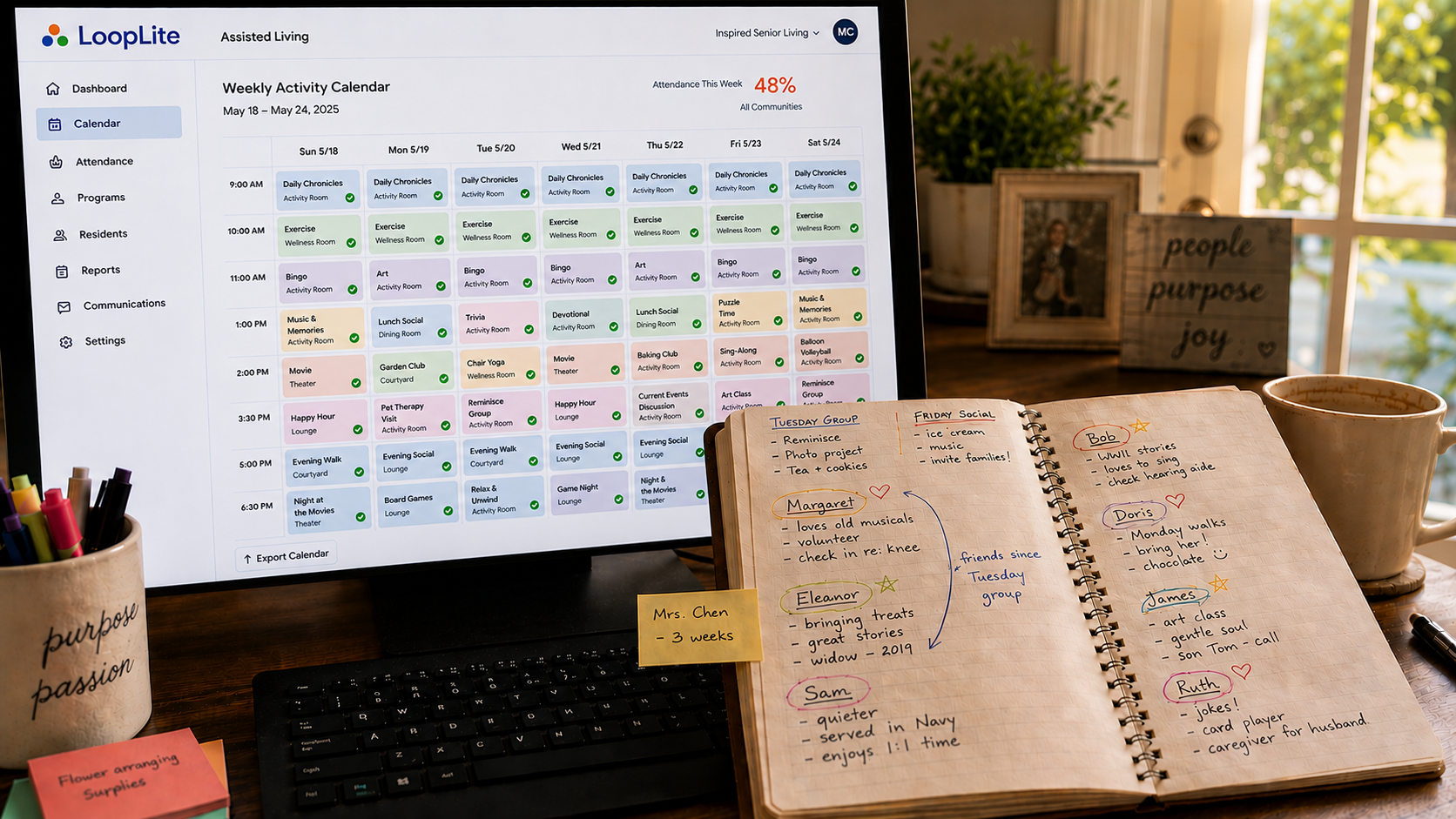
It is Monday morning. She has already walked the community twice, sat with a few staff members over coffee, and caught the overnight nurse on her way past the fitness room to ask about the weekend. She sits down at her desk and opens the activity director software her team has used for years. The first thing she sees is the calendar. The week is color-coded and fully programmed: Daily Chronicles every day at 9, chair yoga at 10, trivia at 2, music therapy on Wednesday, a birthday celebration on Thursday. Attendance from last week shows 38% across all programs. The reports are ready for the executive director.
Everything looks fine.
But she knows that Mrs. Chen has not come to watercolors in three weeks. She knows the new resident in room 212 attended one event his first week and has not returned. She knows the Tuesday afternoon puzzle group has gone quieter since Mr. Abrams passed away last month, and that three of his closest friends have started skipping programs they used to love.
She knows all of this. Her activity director software does not.
Most traditional activity director software was designed to solve a logistics problem: how do you schedule activities, track attendance, and produce reports for state surveys? That is a real problem, and those tools solved it.
But somewhere along the way, the industry accepted that solving the logistics was the same as solving the engagement problem. If the calendar is full and the attendance numbers look acceptable, the software must be working.
It tracks what is scheduled and who showed up, but it cannot see the patterns, signals, and personal context that tell a care team who is disengaging, who is isolated, and who needs a different kind of attention. The centerpiece of the entire category is the event. It should have been the person.
Whether the platform is marketed as assisted living software or retirement community software, the underlying architecture is the same: a calendar at the center, attendance around it, and the resident profile, if it exists at all, stored as an afterthought.
Open any traditional activity director software platform on the market and you will find roughly the same architecture. A calendar view. An attendance tracker. A reporting module that produces participation percentages, program counts, and survey-ready documentation.
These features are useful. They are an advancement over paper sign-in sheets and handwritten calendars. But useful is not the same as sufficient.
The attendance tracker tells you that 18 residents came to Tuesday trivia. It does not tell you that Mrs. Chen used to be one of them and quietly stopped three weeks ago. It counts who showed up. It cannot see who stopped showing up, or why.
The calendar tells you what is scheduled. It does not know whether the resident in room 212 has any interest in what is scheduled, because it knows nothing about who he is, what he did before he moved in, or what might actually draw him out of his room.
The reporting module gives you percentages. It does not give you the context behind the numbers: that your Tuesday puzzle group participation dropped because three residents lost their closest friend in the building last month, and nobody connected that loss to the attendance change.
The best traditional activity director software on the market cannot tell you that Mrs. Chen stopped painting because her daughter moved out of state.
The information that matters most to a life enrichment professional is almost entirely invisible to traditional activity director software. Not because the information does not exist, but because the software was never designed to capture it.
Consider what an experienced activity director actually monitors every day, whether her software helps or not:
These are the six Resident Engagement Intelligence signals. They are what experienced activity directors track instinctively, in their heads, in their notebooks, in the conversations they have with nurses and CNAs in the hallway. They do this work every day without any software support at all.
The question is not whether these signals matter. Every life enrichment professional already knows they do. The question is why the software built for this profession has never been designed to capture them.
If you start with the resident instead of the calendar, everything about the software changes.
The first thing you see is not a schedule. It is a view of who needs attention today and why. Mrs. Chen's participation has declined three weeks in a row. The resident in room 212 has not attended a program since his first week. Three of Mr. Abrams' closest friends have stopped coming to the programs they used to love.
That is what Resident Engagement Intelligence looks like in practice, and it is what Quiltt was built to do. Not a calendar with better features. A fundamentally different starting point. The same information the activity director already carried in her head, now visible to her entire care team.
The resident profile becomes the center of the platform, not the event listing. That profile holds the person's life story, their interests, their important dates, the people they are connected to in the community, and the engagement signals that reveal how they are doing over time. Programming decisions flow from who the residents are, not from what fits neatly into a time slot.
They are inputs into a system that helps care teams understand the people they serve, not just document the activities they offer.
Traditional activity director software was built to answer one question: what is on the schedule? The question it should have been built to answer is: who needs us today?
Activity directors are not event planners. They are engagement professionals who design experiences around the specific people in their care. They read rooms. They notice withdrawal. They remember the anniversary nobody else thought to mark on the calendar. They build one-on-one connections with residents who will never attend a group program but still need to feel known.
For too long, activity director software has treated the profession as if its primary job is scheduling and its primary output is a calendar. The software measured what was easy to count: events held, residents attended, hours programmed. It never measured what actually matters: whether residents are engaged, connected, and known.
Life enrichment software should do more than organize a schedule. It should help the professionals using it see the people behind the attendance numbers. It should surface the resident who is quietly pulling away before anyone has to notice on their own. It should know that Mr. Abrams passed away last month, that three of his friends have stopped coming to programs, and that someone on the care team needs to reach out.
The profession has outgrown the category that was built for it. What it needs now is not a better calendar. It is a system built around the resident, designed to surface the signals that experienced professionals already track in their heads, and capable of giving the entire care team visibility into who needs attention and why.
That is not an upgrade to activity director software. It is a different category entirely. It is Resident Engagement Intelligence.
Q: What is the difference between activity director software and Resident Engagement Intelligence? Activity director software is built around the calendar and the schedule. It tracks what activities are offered and who attends. Resident Engagement Intelligence is built around the resident. It captures participation patterns, social connections, mood signals, life story, life events, and behavioral signals to help care teams understand who needs attention and why. The calendar is one input, not the centerpiece.
Q: Does activity director software track resident engagement? Most activity director software tracks attendance, which is one narrow measure of engagement. It counts who showed up. It does not track whether participation is declining over time, whether a resident is becoming socially isolated, or whether a life event is affecting their engagement. Tracking engagement requires a system that monitors patterns and signals over time, not just headcounts at individual events.
Q: What should senior living communities look for in life enrichment software? Look for software that places the resident profile at the center, not the calendar. The system should capture who each resident is (their life story, interests, and important dates), monitor engagement signals over time (participation patterns, social connections, mood, and behavioral indicators), and surface the residents who need attention before issues become crises. A calendar and attendance tracker are table stakes. The real value is in the intelligence layer above them.