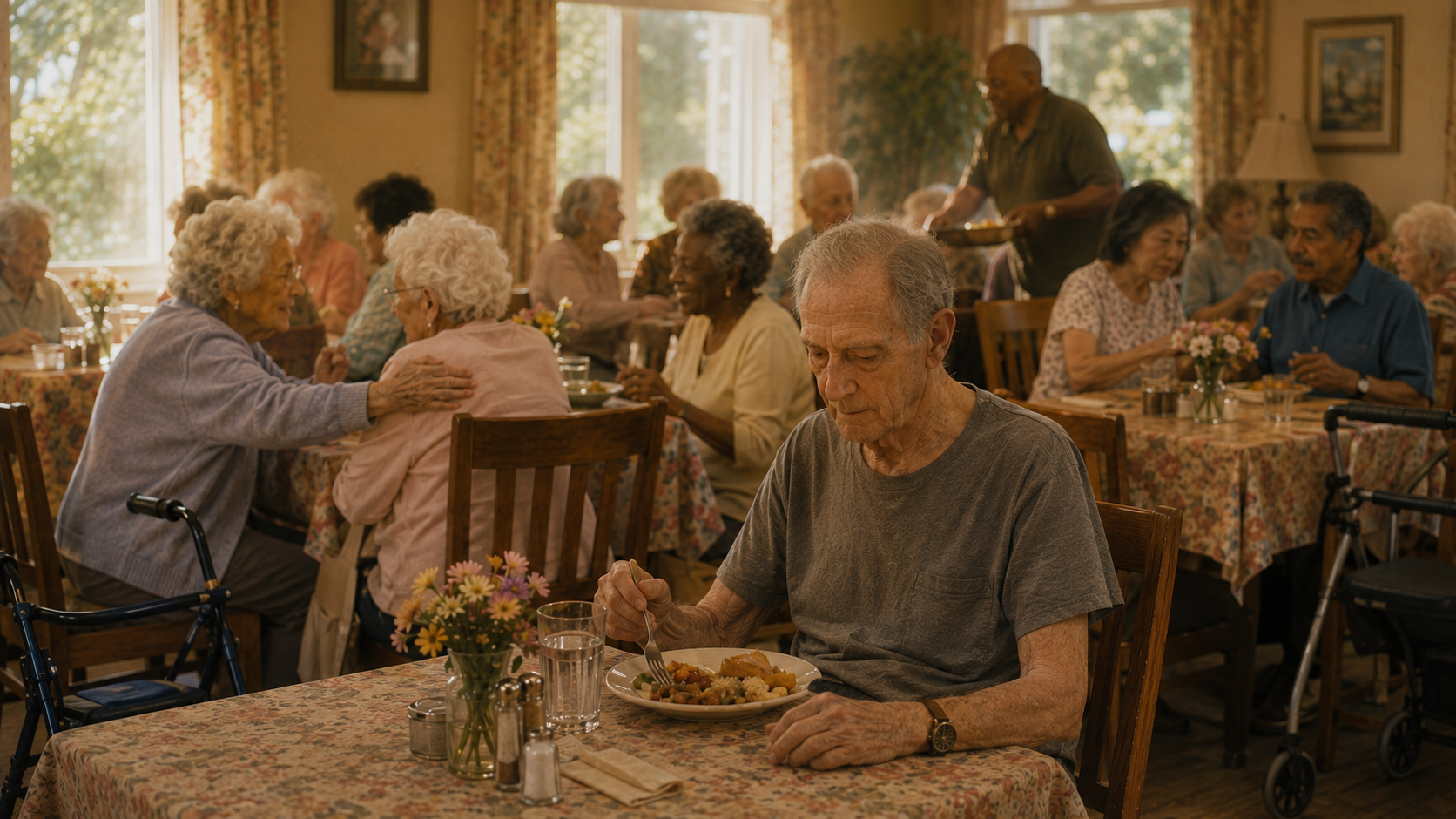
Walter has not missed a program in six months. He is at trivia every Tuesday, the morning exercise class three times a week, and every music event on the calendar. His attendance record is spotless. If you pulled a report from the activity tracking system, Walter would look like one of the most engaged residents in the building.
The activity director sees something different. Walter sits in the back row of every program. He arrives just as it starts and leaves the moment it ends. He eats in the dining room three times a day, always at the same table, but the four people at that table barely speak to each other. He answers trivia questions, sometimes even wins. But he has never stayed for a conversation afterward. In six months of daily programming, Walter has not made a single friend.
On paper, Walter is thriving. In reality, he is one of the most socially isolated residents in the community. And the system designed to track his engagement cannot tell the difference.
Social isolation signals in senior living are different from other engagement signals because they are almost invisible to the systems most communities use. Most communities measure engagement the same way: attendance. How many residents came to the program. How many seats were filled. How many events a resident participated in during the month. And that matters. Tracking attendance is the foundation. It is the baseline signal that gives context to everything else, the starting point for understanding participation patterns, spotting trends, and identifying residents who may need attention. But attendance measures presence. Not social connection. And the two are not the same thing.
A resident can attend every program on the calendar and still have no meaningful relationship with another person in the building. A resident can fill a seat in a dining room three times a day and never have a real conversation. A resident can be physically present in a community of 120 people and be profoundly alone. Participation signals can be counted, and they are essential. Mood signals can be observed and tracked through surveys. Behavioral signals tend to announce themselves when something has already gone wrong. But the Social signal operates quietly. A resident's circle of connection can shrink from five people to one over the course of a few months, and if no one is tracking it, no one will notice until the last relationship breaks.
The tools built for this industry were designed to track activities, not relationships. They can tell you what happened. They cannot tell you who it happened with, or whether it mattered.
The research on social isolation and mortality is not subtle.
A 2010 meta-analysis by Holt-Lunstad et al., published in PLOS Medicine, examined 148 studies with over 308,000 participants and found that people with stronger social relationships had a 50% increased likelihood of survival compared to those with weaker or insufficient social connections. The effect was consistent across age, sex, health status, and cause of death.
To put that in context: the National Academies of Sciences, Engineering, and Medicine reported in 2020 that social isolation carries a mortality risk comparable to smoking, high blood pressure, and obesity. These are conditions that every senior living community screens for, monitors, and builds care plans around. Social isolation is not treated with the same urgency, even though the data says it should be.
The cognitive implications are equally significant. A 2024 meta-analysis published in Nature Mental Health, funded by the National Institute on Aging and drawing from over 600,000 participants across 21 longitudinal cohorts, found that loneliness independently increases the risk of all-cause dementia by 31%.
CMS recognized this in 2018 when F-Tag 679 was updated to require that facility activity programs support not just participation but the "physical, mental, and psychosocial well-being of each resident, encouraging both independence and interaction." The regulatory language already acknowledges that interaction, not just attendance, is the standard. Most communities have the programs to meet this requirement. Fewer have the systems to know whether they are actually achieving it.
Senior living communities are designed to reduce isolation. That is part of the promise: shared meals, group activities, common spaces, a built-in community. But proximity is not connection. A building full of people is not the same as a community where those people know each other. And the assumption that communal living solves social isolation has allowed too many communities to stop looking for it.
Of the 6 Resident Engagement Intelligence Signals, the Social signal captures something the others cannot: connection patterns and isolation signals. Not just whether a resident attends programs, but who they spend time with when they do. Whether their social circle is growing, stable, or contracting. Whether they have relationships that exist outside of structured programming, or whether every interaction is mediated by a scheduled event.
The Social signal is designed to answer questions that attendance data never will:
These are questions that experienced life enrichment professionals carry in their heads every day. They know that Helen and June sit together at every meal and that if one of them gets sick, the other will stop coming to the dining room. They know that the new resident in apartment 310 has not spoken to anyone outside of a group setting in two weeks. They know that three residents lost their closest friend in the building last month and are quietly pulling away from everything.
An activity director with fifteen years of experience can hold the social map of a 60-resident community. She cannot hold it for 200 residents across three shifts. And the rest of the care team, the people making decisions about level-of-care transitions, family communications, and wellness interventions, cannot see what she sees.
The Social signal takes what the best staff already know and makes it visible, persistent, and shareable across the entire team.
Social isolation in senior living does not always look like someone sitting alone in a room. Sometimes it looks like Walter: a resident who shows up to everything but connects with no one. Sometimes it looks like a resident who appears fine because she still attends three programs a week, but her attendance dropped from seven. Her best friend moved to memory care in March, and nobody connected the two events because the system that tracks her programs does not know who she was spending time with.
There are patterns within social connection signals that experienced staff recognize instinctively but rarely have the language or the tools to document.
The companion loss pattern. When a resident's primary social connection leaves the community, whether through a move to a higher level of care, a health crisis, or death, the remaining resident's engagement almost always changes. Sometimes the change is immediate. Sometimes it takes weeks. But the pattern is consistent: participation declines, mood signals change, and social withdrawal follows. Without the Social signal linking these events, the care team sees a resident who "stopped coming to programs" rather than a resident who lost her only friend.
The new resident window. The first thirty days after move-in are the most predictive period for long-term social connection. A resident who has not formed any meaningful relationship in the first month is at significantly higher risk of isolation, dissatisfaction, and early move-out. Most communities track how many programs a new resident attended during orientation. Few track whether that resident has connected with another person.
The table-for-one pattern. Dining is the most natural social environment in a senior living community. It happens three times a day, requires no signup, and places residents in proximity to each other. It is also the place where isolation is most visible to staff who know what to look for. A resident who eats alone once is making a choice. A resident who eats alone every meal for two weeks is sending a signal. A resident who used to eat with a group and now eats alone is sending an urgent one.
The activity-only connection. Some residents have social interactions exclusively within structured programming. They participate, they engage, they even enjoy themselves. But when the program ends, so does the connection. They return to their room. They do not visit other residents. They do not have coffee with anyone between meals. Their entire social life is mediated by the activity calendar. This is not isolation in the traditional sense, but it is fragile. Cancel a program, change a schedule, lose a staff member who facilitated the connection, and the social fabric disappears.
When a community starts tracking social connection signals alongside participation, mood, and behavioral data, the picture of each resident becomes fundamentally more complete.
Care conversations change. Instead of discussing whether a resident "participates enough," teams can ask whether that resident has meaningful relationships. The care plan becomes about the whole person, not just the clinical profile and the activity log. This is what resident engagement looks like when it is built around who a person is, not just what they attend.
Interventions become proactive instead of reactive. A community that can see the companion loss pattern does not wait until the remaining resident has fully withdrawn to respond. It can intervene early: a new dining companion, a small group introduction, a staff member who checks in deliberately rather than accidentally. The Social signal turns observation into early signs of disconnection that care teams can act on before isolation becomes a crisis.
The life enrichment team gains clinical standing. When social connection signals are treated as health data, the professionals who observe and influence those connections belong in care planning meetings. Their observations about who is connected, who is drifting, and who lost their closest friend last month are not anecdotes. They are engagement intelligence, and they deserve the same weight as clinical vitals in the picture a care team uses to understand each resident.
Families get a fuller picture. When a daughter asks how her mother is doing, the answer should not be limited to medication compliance and program attendance. It should include whether her mother has friends. Whether she is eating with people she enjoys. Whether she has connected with anyone new since her longtime companion passed away. Social connection is not a luxury metric. For older adults, it is a health indicator as significant as blood pressure. And as resident engagement platforms continue to evolve, the ability to track social connection alongside clinical data will become a baseline expectation, not a differentiator.
Walter is still attending every program. His attendance record is still spotless. But the activity director flagged something three weeks ago: Walter has no social connections in the building. He participates, but he does not connect. He is present, but he is alone.
Because that observation is now visible to the care team, something changed. A staff member introduced Walter to a small men's discussion group that meets on Thursday mornings. The group has six regulars who knew each other before Walter moved in. The format is structured enough to give Walter something to focus on and informal enough to let conversation happen naturally.
It has been three weeks. Walter still sits in the back row at trivia. He still leaves as soon as it ends. But on Thursday mornings, he stays. He talked to a retired engineer named Frank about a bridge project Frank worked on in the 1970s. He asked if the group meets next week.
Nobody would have noticed what Walter needed if the only data the community had was how often he showed up. The Social signal does not replace what experienced staff already know. It makes sure the rest of the team can see it too, so that no resident, especially the ones who look fine on paper, slips through the cracks.