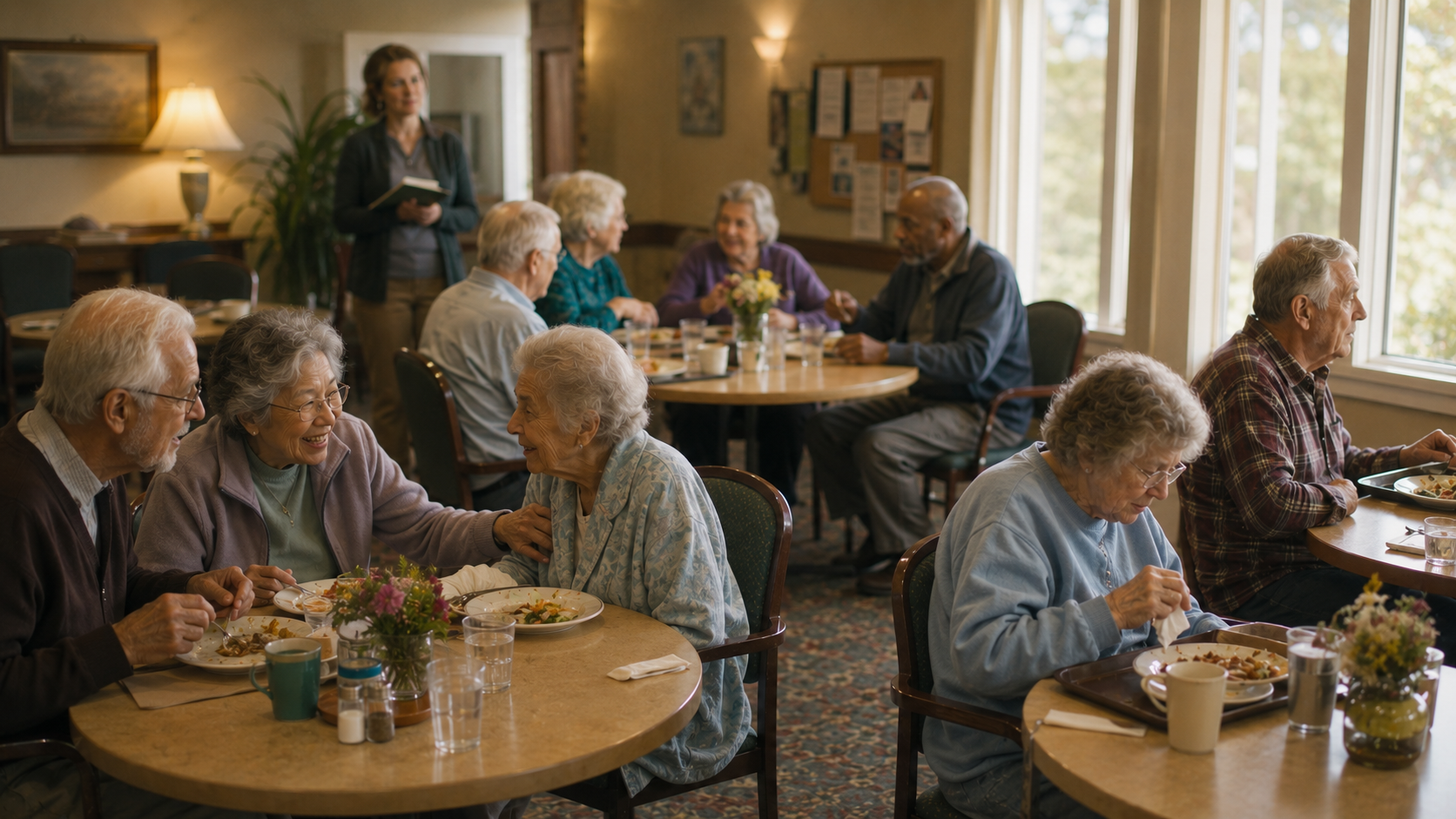
Proximity is not connection.
A senior living community can house 120 residents under one roof, serve meals in a shared dining room three times a day, and offer a full calendar of group programming, and still produce residents who are profoundly alone. Living near other people is not the same as being connected to them. Sharing a hallway is not the same as sharing a friendship. And filling a room for an activity is not evidence that anyone in that room has a meaningful relationship with anyone else.
Connection does not happen because a community exists. It happens because someone designed for it.
That distinction matters more than most of this industry has been willing to acknowledge. We build communities around clinical care, around safety, around compliance. We design hallways for wheelchair clearance, call systems for emergencies, and common areas for capacity. All of that is necessary. None of it produces connection. Connection requires a different kind of design: one that treats social engagement as an outcome worth measuring, not a byproduct worth hoping for.
Of the six Resident Engagement Intelligence signals, the Social signal is arguably the hardest to see without the right systems in place.
Participation is visible. You can count who showed up. Mood is observable and can be tracked through regular surveys. Behavioral signals announce themselves when something has already gone wrong. But Social connection operates quietly. A resident's friendship circle can shrink from five people to one over the course of three months, and if nobody is tracking it, nobody will notice until the last connection breaks.
The Social signal tracks connection patterns and isolation signals. Not just whether a resident attends group activities, but who they spend time with when they do. Whether their social circle is growing, stable, or contracting. Whether they have relationships that exist outside of structured programming, or whether every interaction they have is mediated by a scheduled event. Whether a new resident has formed any connections at all in the first thirty days, or whether they are eating every meal alone and returning to their room after every program.
This is information that experienced life enrichment professionals already carry in their heads. They know that Margaret and Ruth sit together at every meal and that if one of them stops showing up, the other will too. They know that the new resident in 214 has not spoken to anyone outside of a group setting in two weeks. They know that three residents lost their closest friend in the building last month and have started pulling away from the programs they used to love.
The problem is not that this knowledge does not exist. The problem is that it lives in one person's head and disappears when that person is off shift, changes roles, or leaves the organization. The Social signal is invisible not because it is hard to observe, but because the systems built for this industry were never designed to capture it.
This is not a failure of intention. It is a failure of architecture.
Senior living communities are designed, down to the floorplan, around clinical care and operational efficiency. The physical environment is built for safety: grab bars, emergency pull cords, wide doorways, fall prevention lighting. The technology stack is built for documentation: EHRs, medication management, incident reporting, regulatory compliance. The staffing model is built for acuity: nurses per resident, CNAs per unit, clinical oversight ratios.
All of this infrastructure exists because the industry correctly understood that clinical care requires systems. You cannot deliver safe, consistent clinical care by relying on individual memory, verbal handoffs, and instinct. You need structure. You need data. You need visibility.
Engagement has never received that same investment. The infrastructure built for community life in most senior living organizations is a calendar, an attendance tracker, and a filing cabinet. The tools designed to support connection are the same tools that were designed to schedule bingo and produce monthly reports. They can tell you how many people came to Tuesday trivia. They cannot tell you whether anyone in that room has a friend.
If proximity produced connection, every senior living community in the country would already have it. The fact that social isolation remains one of the most persistent challenges in senior living tells us something important: connection requires design. It requires intentionality in how spaces are used, how programming is structured, how staff observe and respond, and how systems surface what is actually happening between residents.
Programming designed for connection, not just participation. The question is not whether an activity fills seats. It is whether the activity creates the conditions for relationship. Small group experiences, shared creative projects, recurring gatherings with consistent participants: these build connection over time in ways that a rotating calendar of one-off events cannot. The best life enrichment professionals already design this way. The systems they use should support it, not ignore it.
Staff trained to observe connection, not just attendance. When a care team member walks through the dining room, what are they trained to see? An empty chair is easy. The resident who is sitting at a table but not speaking to anyone, the resident whose dining companion moved to memory care last month and has not been reseated, the new resident eating alone for the twelfth day in a row: these are Social signals. They require observation, and they require a system that makes the observation shareable and actionable across the entire team.
Physical spaces that invite interaction. This is not about building new wings or renovating common areas. It is about how existing spaces are used. A long table seats more people but produces fewer conversations than several small tables. A community garden creates different kinds of connection than a lecture hall. A reading nook near a high-traffic area can draw someone out of their room more effectively than a scheduled program. Designing for connection means asking, for every shared space, whether the space makes it easier or harder for two people to become friends.
Technology that surfaces what staff cannot see at scale. An activity director with 15 years of experience can hold the social map of a 60-resident community in her head. She knows who is connected, who is drifting, and who needs someone to reach out. But she cannot hold the social map of a 200-resident community across three shifts. And when she goes home for the weekend, that map goes with her. Technology designed for connection does not replace her expertise. It makes it visible to everyone, persistent across shifts, and actionable before isolation becomes a crisis.
When you treat connection as something worth designing for, the Social signal stops being a passive observation and becomes an active design principle. It shapes decisions.
A community that tracks Social signals knows, within the first thirty days, whether a new resident has formed any connections. That is not a nice-to-have metric. It is a predictor of long-term satisfaction, engagement, and retention. A resident who has not connected with another person in the first month is at significantly higher risk of withdrawal, dissatisfaction, and early move-out.
A community that tracks Social signals can see when a resident's friendship circle contracts after a loss. Not just that the resident stopped attending programs, which is a Participation signal, but that the specific people they used to spend time with are also pulling away. The Social signal provides context that attendance data alone cannot: it tells you not just that something changed, but what changed and who is affected.
A community that tracks Social signals can design programming that responds to what it sees. If the data shows that a group of residents share a connection but have never been in the same program together, that is information the activity team can act on. If the data shows that a resident participates in group activities but has no one-on-one connections, that is a different kind of signal that calls for a different kind of response.
This is what resident engagement looks like when it is built around the person instead of the calendar. The Social signal does not just measure connection. It gives care teams the information they need to create it.
The word "community" gets used loosely in senior living. It appears on brochures, in mission statements, on the signage outside every building. But a community is not a place. It is a pattern of connection between people, and that pattern either grows or erodes depending on whether anyone is paying attention to it.
The communities that will define the next standard for this industry are the ones that treat connection as a design problem, not a scheduling problem. They are the ones that invest in the systems, the training, the programming, and the physical environments that make it possible for two people to become friends, for a grieving resident to be noticed before they disappear, and for a new arrival to feel like they belong before the first month is over.
Designing communities for connection is not a secondary priority that lives beneath clinical care. It is a foundational one. Because a resident who is connected, who has friendships, who feels known and seen by the people around them, is a resident who is more likely to thrive in every other dimension of care. The Social signal is not separate from health outcomes. It is one of the strongest predictors of them.
The question for every operator, every executive director, and every person responsible for the experience inside a senior living community is simple: is your community designed for connection, or is it just designed for proximity? The answer shows up in the data, if you have the systems to see it.