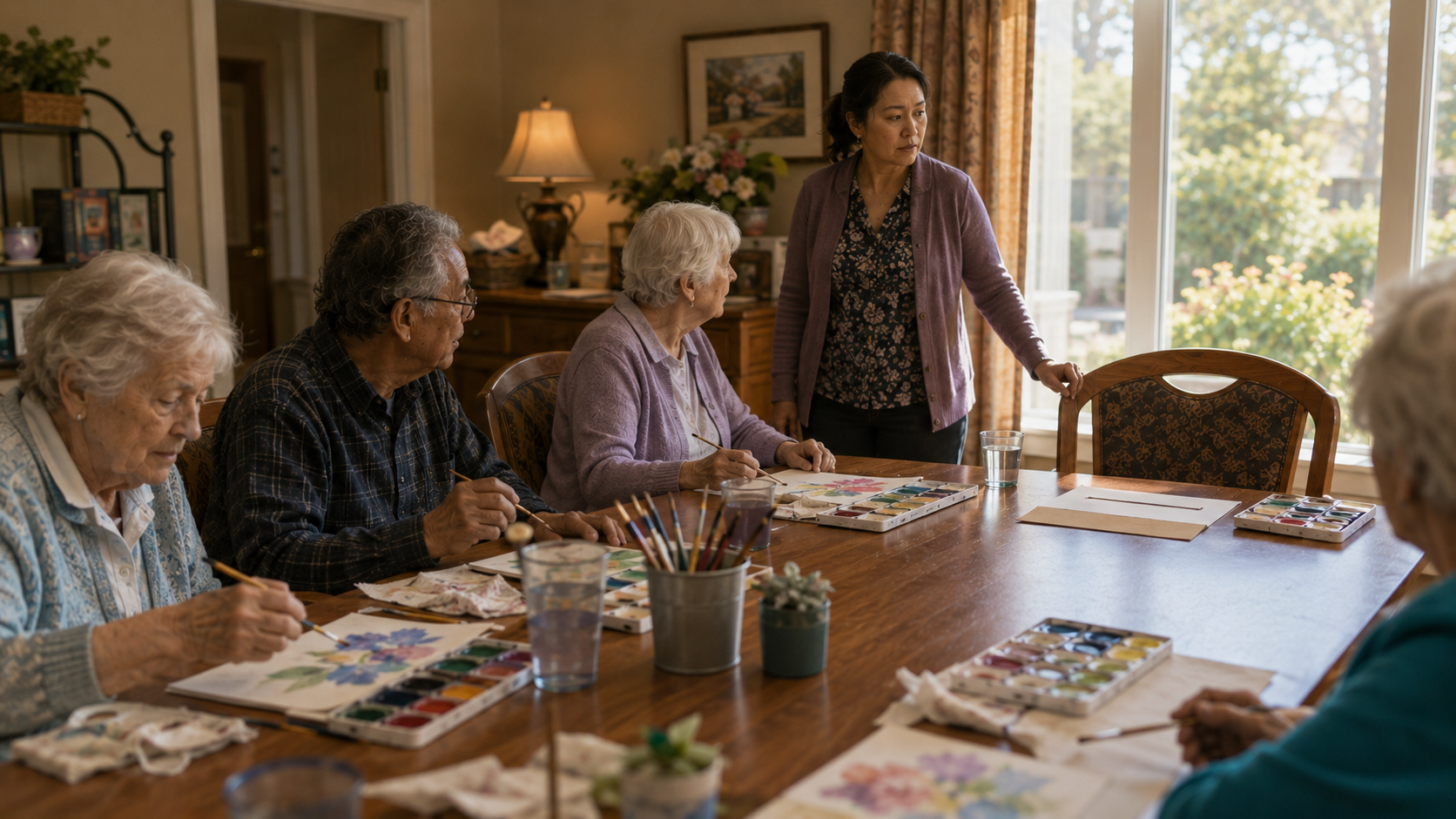
Margaret used to be the first one in the arts and crafts room every Wednesday morning.
She arrived ten minutes before the Artfully Aging watercolor class started, set her supplies at the table by the window, and chatted with whoever sat down next to her. She had been doing this for eleven months, ever since she moved in after her husband passed. Watercolors were not her first love. Her husband had been the painter. But sitting with the brushes and the colors and the quiet concentration of the group made her feel connected to something she was not ready to let go of.
Three Wednesdays ago, she stopped coming. Kelly, the life enrichment director, noticed, mentioned it to a colleague in the hallway, and made a mental note to check in. But by Thursday, a fire drill, a family complaint, an unplanned inspection, and several last-minute schedule changes had pushed the mental note aside. Margaret missed the next Wednesday too. And the one after that.
By the time anyone formally documented a change, it was the nursing team, six weeks later, noting increased agitation and withdrawal on a clinical assessment. The physician reviewed the chart, saw no recent engagement notes, and prescribed a low-dose antipsychotic. Margaret became quieter. She stopped coming to the dining room for meals. The medication was doing what it was prescribed to do. The agitation was managed. But Margaret was disappearing in every way that mattered, and nobody could point to the moment it started.
The life enrichment team did not miss her on purpose. They just did not have a system that noticed she was gone.
Of the six Resident Engagement Intelligence signals that senior living communities should be tracking, Participation is the one that gives every other signal its context.
Mood signals require interpretation. Social signals require observation over time. Life Story and Life Events require conversations that may take weeks to develop. Behavioral signals often surface only after something has already changed. But participation is concrete. A resident either showed up or she did not. She attended three times this week or once. She has been at every music program for six months or she stopped coming in March. Participation is the signal with the clearest data trail, and for most communities, it is the one closest to being trackable right now.
That is what makes it the bedrock. Not because it tells you everything about a resident's wellbeing, but because it tells you where to look. A sudden drop in participation does not diagnose the problem. But it raises the question. And raising the question at week two instead of month three is the difference between an engagement conversation and a clinical intervention.
Participation patterns also activate the other five signals. You cannot identify social isolation without knowing who is connecting with whom during group activities. You cannot assess mood changes without a baseline of normal engagement. You cannot recognize the impact of a life event without seeing the before and after in someone's attendance. Participation is the first signal, not because it is the most important in isolation, but because it is the foundation that gives all the others their meaning.
Most senior living communities know that tracking participation matters. Many are trying. But the tools and methods available to them have made it nearly impossible to do well.
Paper sign-in sheets remain the most common tracking method in the industry. A clipboard sits by the door. Residents sign in, or a staff member checks names off a printed list. At the end of the day, someone files the sheet in a binder that nobody opens again until someone asks for documentation.
This method counts bodies. It does not count patterns. It cannot tell you that Margaret came to Watercolor Wednesday every week for eleven months and then stopped. It cannot tell you that three residents in memory care attended fewer activities this month than last. It cannot surface a trend because it was never designed to. It was designed for compliance, not engagement intelligence.
Spreadsheets are the next step up, and in some ways, the most frustrating. A motivated life enrichment director opens an Excel file, types in names and dates, and intends to analyze the data at the end of the month. But the month gets away from her. The entries become inconsistent. Some events are tracked, others are not. By the time anyone looks at the spreadsheet, it is incomplete, outdated, and too scattered to reveal anything useful.
Traditional resident engagement platforms represent the most sophisticated attempt, and in many ways, the most disorienting. These systems do track attendance. But the data is buried in reporting modules, surfaced in spreadsheet-like exports alongside sales pipeline metrics, occupancy reports, and care documentation. The systems were designed for administrators, not for a life enrichment professional standing in the hallway wondering who needs her attention today. Making sense of participation trends requires workarounds: exporting raw data, building custom reports, or manually cross-referencing spreadsheets. Few life enrichment teams have the time or technical background to sustain that process month after month.
And some of these senior living resident engagement software platforms have begun layering AI on top of the data, or claiming to, attempting to automate engagement decisions without involving the most perceptive person in the building: the life enrichment professional. The person who knows Margaret. The person who noticed she seemed quieter last week. The person who understands the difference between a resident who skipped an activity because she was tired and one who skipped it because something deeper has changed. Removing her from that process does not make the system smarter. It makes it blind to the context that only a human being can provide.
Memory is the method nobody talks about but nearly everyone relies on. The life enrichment director knows her regulars. Kelly knows who comes to bingo every Thursday and who only shows up for live music. She carries this knowledge in her head, and for the residents she sees most often, it works. Until she is out sick for a week. Until she takes a new position at another community. Until she is buried in planning and gets trapped at her desk for three days. The knowledge leaves when she does, and there is no handoff because nothing was ever written down.
And increasingly, the reason Kelly leaves is not just workload. It is burnout. Senior living continues to lose its best life enrichment professionals to a kind of exhaustion that goes beyond hours and staffing ratios. Much of it can be traced to the planning burden. Also, the emotional weight of carrying all of this intelligence alone: every resident's patterns, preferences, relationships, and warning signs, held in one person's memory with no system to share the load. And when they go, the community does not just lose a staff member. It loses the only copy of everything she knew.
And then there are the communities that have stopped trying altogether. Not because they do not value tracking, but because they cannot find the time. They are short-staffed, stretched across multiple care levels, and participation tracking feels like one more administrative demand on a team that is already drowning in them. They know they should be doing it. They recognize the value. They just cannot get the job done.
The result, across all of these scenarios, is the same: participation is tracked inconsistently, informally, and only for select events. A handful of large group activities might get a sign-in sheet. But one-on-one engagements, ad hoc interactions, and small-group sessions almost never get documented. And those are often the most meaningful touchpoints a life enrichment team has with its residents.
Attendance answers a simple question: how many people came? Participation intelligence answers a different one entirely: what is changing, and what does it mean?
Attendance is a snapshot. Participation intelligence is a story told over time. It is the difference between knowing that fourteen residents attended the Tuesday afternoon music program and knowing that one of those fourteen used to attend four programs a week and now attends one. The first number goes in a report. The second number is a signal that something in that resident's life has changed.
Trend analysis requires consistency. It requires tracking every group event, not just the ones with a sign-in sheet at the door. It requires documenting one-on-one engagements and ad hoc interactions, not just the programs on the calendar. It requires a baseline for every resident, because a drop in participation means nothing without knowing what participation looked like before.
This is where the distinction between tracking attendance and tracking participation patterns becomes critical. Attendance tracking asks: did they come? Pattern tracking asks: is this different from last week? Last month? The last three months? A single missed Wednesday may not be a meaningful signal. Three missed Wednesdays in a row, from a resident who attended forty-four consecutive weeks before that, is.
Pattern recognition over time is what transforms raw attendance data into something actionable. When a community can see three weeks of declining participation before it becomes six weeks of clinical documentation, the response changes entirely. The life enrichment team can reach out directly. They can have a conversation. They can adjust programming, offer a one-on-one visit, or simply sit with someone and ask how she is doing. That is an engagement intervention. It costs nothing, requires no prescription, and addresses the root cause instead of managing the symptom.
But pattern recognition requires data that most communities do not have, collected with a consistency that most methods cannot sustain, analyzed with a frequency that most teams have never been resourced to maintain.
When participation patterns are invisible, the first formal documentation of a resident's decline almost always comes from the clinical side. A nurse notes agitation during a routine assessment. A physician sees behavioral changes with no corresponding engagement notes and prescribes a psychotropic medication. In too many cases, this is the default path: an antipsychotic, an antidepressant, or an anxiolytic prescribed to manage a condition that might have been addressed differently if it had been identified earlier and through a different lens.
The overuse of psychotropic medications in senior living has been a regulatory and advocacy concern for over a decade. These medications are associated with increased fall risk, accelerated cognitive decline, and reduced lifespan in older adults. They are sometimes necessary. But they should never be the default response to a problem that started with disengagement and could have been caught with better visibility into participation patterns.
The alternative is not complicated. It is early visibility. When a community can see that a resident's participation has dropped, the life enrichment team can respond with what they were trained to do: connect. A conversation. A personalized activity invitation. A one-on-one visit. These are engagement interventions: non-pharmacological, human, and rooted in knowing who the resident is and what she needs. They address the cause, not the symptom. And they protect something the health community is increasingly focused on: not just lifespan, but healthspan.
Healthspan is the number of years a person lives free from significant chronic disease or disability, and by that measure, the United States is moving in the wrong direction. According to the World Health Organization, the average healthspan for U.S. adults dropped from 65.3 years in 2000 to 63.9 years in 2021. Research consistently identifies strong social connections as one of the key factors that contribute to a longer healthspan, alongside physical activity, nutrition, and clinical health management. Life enrichment professionals build and protect those social connections every day. Participation tracking is how a community knows whether those connections are holding or falling apart. When engagement is treated as care, it becomes a healthspan intervention: not just a calendar of activities, but a measurable contribution to the years a resident lives well.
A 2023 meta-analysis spanning 1.3 million participants found that social isolation carries a 33% increased risk of all-cause mortality. A 2025 review of 86 studies confirmed a 35% increase. Earlier research by Holt-Lunstad found the mortality risk comparable to smoking fifteen cigarettes a day. Participation tracking is one of the most direct ways a community can identify residents at risk of isolation before the clinical consequences begin. The data is not ambiguous. The question is whether communities have the systems to act on it.
When participation signals are visible, the life enrichment team stops operating in the dark. They are no longer relying on memory, intuition, or chance encounters to know who needs attention. They have a baseline for every resident. They can see when something changes. And they can respond the same week, not six weeks later.
This is what it means to use engagement as a function of care. Not as a line item on the activity calendar, but as a genuine health intervention that operates alongside clinical monitoring, nutritional support, and medication management. When a life enrichment professional notices a participation pattern and responds with a personalized engagement, she is doing care work. She is preventing isolation, preserving cognitive function, and protecting a resident's quality of life in ways that a clinical chart alone will never capture.
Early visibility also transforms how teams work together. When participation data is shared across departments, the conversation between life enrichment and nursing changes. Instead of the clinical team flagging behavioral changes after the fact, the engagement team can surface participation trends proactively: "Margaret has missed three consecutive Wednesday programs. Has anything changed clinically?" That question, asked early, changes the trajectory of care for that resident.
It changes the conversation with families too. A family member who hears "your mother has attended fewer activities this month, and we wanted to check in with you to understand if anything has changed" is hearing something fundamentally different from "your mother has been prescribed a new medication for agitation." The first is a community that is paying attention to participation signals. The second is a community that is reacting.
This is the foundation of Resident Engagement Intelligence in senior living. Participation is the bedrock signal because everything else builds on it: Social connection patterns, Mood changes, Life Story details that surface significant context about who a resident is, Life Event impacts, Behavioral expressions. Without consistent participation data tracked over time, those signals lack the context to become actionable. With it, a community has the foundation to see every resident as a whole person, not just the ones who happen to be in the room when someone is looking.