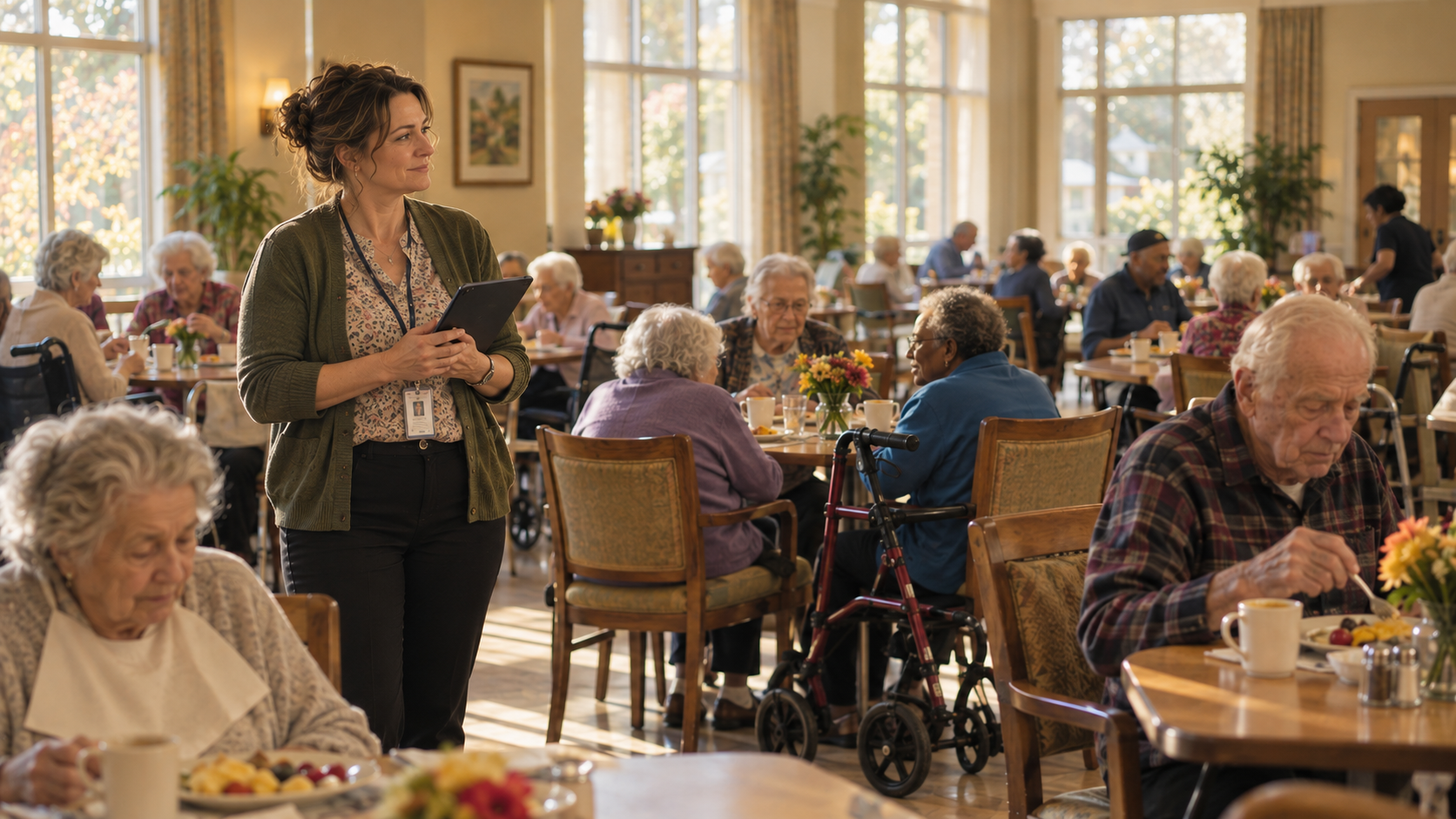
Denise has been a life enrichment director for eleven years. She is very good at her job. And every morning, she does something that no technology in her building can do for her.
She walks the hallways before breakfast and pieces together what happened overnight. She checks in with the night shift CNA who mentions that Walter was up at 3 a.m. again. She glances at the dining room and notices that Margaret is sitting alone for the third morning in a row. She pulls up the activity calendar on her laptop, reviews the sign-in sheets from yesterday's programs, and compares them against the mental list she carries of who has been pulling away, who just lost a spouse, and who has a birthday coming up that nobody else remembers.
By the time her first program starts at 10 a.m., Denise has already built a picture of her community that no system in the building contains. The EHR has clinical data. The CRM has marketing data. The calendar has scheduling data. But the intelligence that Denise just assembled, the human picture of who is thriving, who is struggling, and who needs something different today, lives nowhere except in her head.
That is about to change.
For most of its history, senior living software has been organized around one thing: the activity calendar. The tools got better over the years. Paper calendars became digital. Sign-in sheets moved to tablets. Family communication apps added photo sharing and event updates. Each generation of technology made the existing workflow faster, cleaner, and more convenient.
But the center of gravity never moved. The calendar stayed at the middle of everything. And the fundamental question the technology answered stayed the same: what events are scheduled, and who showed up?
That question is not wrong. Participation tracking matters. Scheduling matters. Communication with families matters. These are essential capabilities, and every community needs them.
The problem is that the question is incomplete. It captures what happened during a scheduled program. It does not capture what happened everywhere else: in the dining room, in the hallway, during a family visit, at 3 a.m. when a resident could not sleep. It does not capture who a resident is, only whether they attended. And it does not connect the patterns that reveal something important is changing in a resident's life before that change becomes a crisis.
The future of engagement technology in senior living is not a better calendar. It is a fundamentally different kind of system, one organized around the resident instead of the schedule.
Three things are converging to make this possible.
First, the data already exists. Every community generates an enormous amount of information about its residents every day. Participation patterns. Dining observations. Staff notes. Family conversations. Mood changes. Social dynamics. Birthdays. A daughter who stopped calling. A morning routine that quietly disappeared. This information has always existed. It has just never had a system to hold it, connect it, or make it visible.
Second, the science is clear. The research on social isolation, cognitive reserve, and non-pharmacological intervention has established that resident engagement is not a quality-of-life amenity. It is a health outcome. The 2024 Lancet Commission identified social isolation as a modifiable risk factor for dementia, alongside hypertension and diabetes. When engagement is a clinical concern, the technology that supports it cannot remain a scheduling tool.
Third, the profession is ready. Life enrichment professionals have always known more than their tools could express. They have carried the intelligence in their heads, shared it in hallway conversations, and lost it every time someone transferred, retired, or called in sick. The profession does not need to be convinced that engagement matters. It needs infrastructure that matches what it already understands.
The next generation of resident engagement software does not replace the calendar. It puts the calendar in its proper place: as one input among many, inside a system that sees the whole picture.
A Resident Engagement Intelligence System is built around six categories of signal that communities already generate but have never connected:
These are the 6 Resident Engagement Intelligence Signals. The future of senior living engagement technology is a system that reads them together, connects them over time, and surfaces the patterns that tell staff who needs attention, why, and what kind of response will actually help.
This is not speculative. This is the direction the category is already moving.
The most important thing the next generation of engagement technology does is solve a problem that has defined the profession for decades: institutional memory.
Denise is extraordinary at her job. She carries a detailed picture of 80 residents in her head, and she updates it every morning through observation, conversation, and intuition. But that picture is fragile. When Denise is out sick, it goes with her. When she takes a vacation, the staff who cover for her do not have access to what she knows. When she eventually moves on, the next person starts from scratch.
This is not a criticism of Denise. It is a criticism of a technology environment that forces the most important intelligence in the building to live in one person's memory.
The future of engagement technology makes what Denise knows visible to the whole team, every day, across every unit and every care level. When a CNA observes a mood change, it enters the system. When a family member shares that her father's anniversary is next week, it enters the system. When participation data reveals that a resident has missed her favorite program three weeks in a row, the pattern surfaces automatically. The picture Denise builds in her head every morning becomes institutional knowledge that persists across staff changes, shift changes, and sick days.
The second transformation is about timing.
Today, most communities discover that a resident is disengaging weeks or months after the pattern started. The clinical team documents behavioral changes. A physician may prescribe medication. A care transition conversation begins. By the time anyone formally responds, the situation has been developing in plain sight, through signals that no system was collecting.
The future of engagement technology does not predict the future. That is not the claim. What it does is make existing patterns visible sooner. When a resident's participation drops in the same week her dining companion moves to memory care, that is not two unrelated data points. That is a story. And a system that connects those signals gives the engagement team the chance to respond in week one, not month three.
The intervention at week one looks different from the intervention at month three. At week one, it might be a seating change in the dining room. A personal invitation to a small group activity. A conversation with the family about what changed. At month three, it is a care planning meeting, a medication review, and a conversation about whether the resident needs a higher level of support.
Early visibility does not guarantee a different outcome. But it changes the options available. And it changes them dramatically.
The future of engagement technology in senior living is not just about better software. It is about a different role for the people who use it.
When engagement technology is a calendar tool, the life enrichment director is a programmer. She plans events, promotes them, runs them, and counts attendance. Her value is measured by how many activities she offers and how many people show up. That is an important job. It is also an incomplete description of what life enrichment professionals actually do.
When engagement technology is an intelligence system, the life enrichment director is a care partner. She still programs, still plans, still runs activities. But she also reads signals, identifies residents who need a different kind of attention, and coordinates responses with the care team, the dining team, and the family. Her value is measured by outcomes: who is thriving, who is connected, who was at risk of falling through the cracks and did not.
That is a fundamentally different professional identity. And it is one that life enrichment professionals have been ready for long before the technology caught up.
The future of engagement technology is not arriving someday. It is arriving now. And the decisions communities make about their activity director software in the next few years will determine whether they are building on a foundation that supports where the profession is heading, or locking into a platform that was designed for a previous era.
Communities evaluating resident engagement software should be asking questions that go beyond the calendar interface: What signals does the system track beyond attendance? How does it connect what staff observe with what families share with what the data reveals? Does it give care teams a picture of who needs attention today, or just a record of what happened yesterday?
These are the questions that separate a scheduling application from an engagement intelligence system. And they are the questions that will define which communities see the full picture of their residents' lives, and which ones continue to rely on the extraordinary memory of one person who carries it all in her head.
Denise should not have to be the system. She should be the person the system supports.