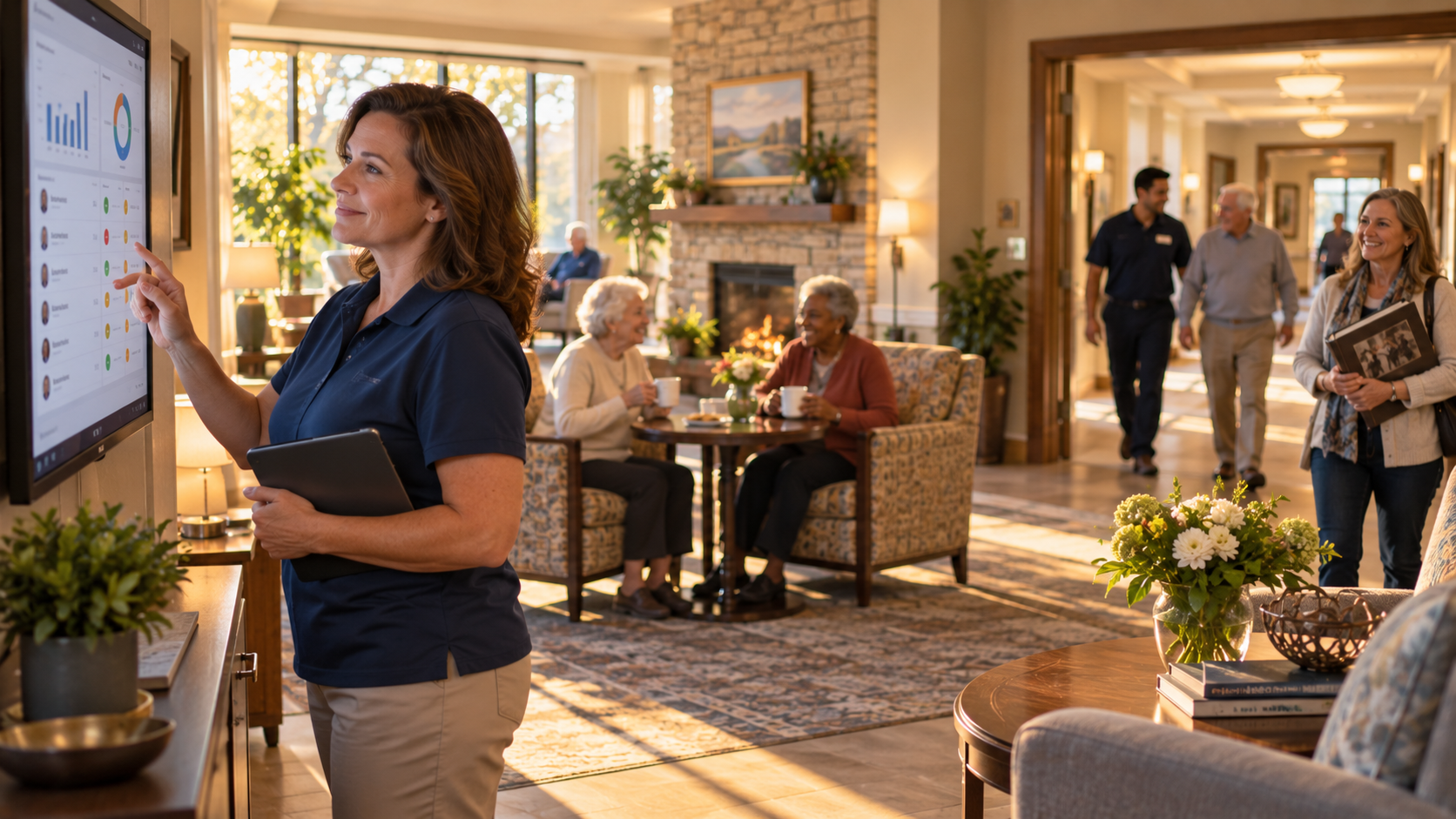
Every department in a senior living community has an operating system. Clinical care runs on the electronic health record. Operations runs on facilities management software. Sales and marketing run on the CRM. Dining runs on its own platform. Billing, HR, compliance, maintenance: each one has a system that organizes the work, surfaces what needs attention, and makes information visible to the people who need it.
Now ask what system runs community life. What organizes how residents are known, how their engagement is tracked, how staff learn who needs connection today, how families contribute what they know, and how the life enrichment team coordinates the most human work in the building?
The answer, in most communities, is nothing. Community life runs on memory, paper sign-in sheets, a shared calendar, and the individual heroics of one or two people who carry every resident's story in their heads. It is the most important experience a senior living community delivers, and it is the only one without an operating system.
An operating system is not an application. It is not a feature. It is the layer that makes everything else work.
In computing, the operating system sits between the hardware and the software. It manages inputs, coordinates processes, allocates resources, and surfaces outputs. Without it, the hardware is capable but directionless. Individual applications might function, but nothing connects them. Nothing ensures that what one part of the system knows is available to the rest.
The parallel to community life in senior living is uncomfortably precise. The hardware exists. Residents are living in the building. Staff are working the floor. Families are calling, visiting, sharing information. Activities are happening. Meals are being served. Conversations are unfolding in hallways and lobbies and gardens. The raw material of community life is everywhere.
But there is no coordinating layer. No system that takes what staff observe, what families share, what the data reveals, and what residents express through their daily patterns and connects it into something the whole organization can see and act on. The inputs exist. The operating system does not.
Without an operating system, engagement runs on a collection of disconnected tools and informal practices that were never designed to work together.
The activity calendar handles scheduling. Sign-in sheets handle attendance. A binder or spreadsheet holds resident preferences, if someone took the time to write them down. A life enrichment director carries a detailed mental map of which residents are thriving, which are withdrawing, and which need a different kind of attention this week. A CNA notices something about a resident's mood and adds a note to the care plan in the EHR, where it sits in a clinical record that the life enrichment team never opens. A family member shares that her father was a jazz musician for forty years, and the detail lives in a single onboarding form that nobody opens again.
Each of these inputs is valuable on its own. None of them are connected. The calendar does not talk to the resident profile. The attendance data does not surface patterns over time. The CNA's observation does not reach the life enrichment director unless they happen to cross paths. The family's contribution does not shape programming unless someone remembers it.
This is what it looks like when a critical function runs without an operating system. Not failure. Fragmentation. The pieces are all there. They just do not know about each other.
The activity calendar is the closest thing most communities have to a coordinating system for engagement. It organizes programming, communicates the schedule, and gives the life enrichment team a visible artifact of their work. For that purpose, it is effective.
But a calendar is an application, not an operating system. It does one thing well: it schedules events and tracks who showed up. It does not hold resident engagement data beyond attendance. It does not connect life stories to programming decisions. It does not surface patterns that suggest a resident is withdrawing. It does not give the care team a picture of who needs attention today and why.
Treating the calendar as the operating system for community life is like treating a word processor as the operating system for a computer. It is a useful tool running on top of an infrastructure that does not exist. And when the infrastructure does not exist, every other tool is limited by what it cannot see.
The industry does have a technology category called the senior living resident engagement platform. These systems represent a meaningful step forward from paper calendars and binders. They digitize scheduling, simplify attendance tracking, streamline communication with families, and give life enrichment teams a more organized way to manage programming. They are useful. They are necessary. And they are not operating systems.
A traditional resident engagement platform, also known as activity director software, is still, at its core, organized around the activity calendar. It makes the calendar digital. It makes attendance tracking easier. It may add a family communication layer or a content library. But its center of gravity is the same: scheduled programming, group events, and the data that flows from them. It is a better application for the work the life enrichment team already does. It is not the coordinating layer that connects what the whole community knows about each resident into something everyone can see and act on.
In operating system terms, the traditional resident engagement platform is a better word processor. It does its job well. But it is still an application running on top of an infrastructure that does not exist.
The operating system for community life has to do everything the traditional resident engagement platform does: scheduling, attendance, programming, communication. Those are essential features, and no community can function without them. But the operating system has to go further. It has to aggregate and connect the signals that no calendar-centric system was ever designed to see.
A Resident Engagement Intelligence System does both. It provides the workhorse features that life enrichment teams depend on every day, and it layers on top of them the aggregation and scoring of six categories of signal that communities already generate but rarely connect:
These are the 6 Resident Engagement Intelligence Signals. An engagement operating system reads them together, in context, over time. It does not just store them. It aggregates them, scores them, and surfaces the patterns that tell staff who needs attention, why, and what to do about it.
When a resident's participation drops in the same week her daughter's visits became less frequent, that is not two unrelated data points. That is a story. A traditional platform sees neither. An engagement operating system sees both, connects them, and puts the pattern in front of the person who can respond.
When engagement has a coordinating layer, three things change that are impossible without one.
First, staff stop relying on memory to know who needs them. The life enrichment director who carries every resident's story in her head is doing extraordinary work, but her knowledge is fragile. It disappears when she is out sick, when she transfers to another community, when the building gets large enough that one person cannot hold it all. An operating system makes what she knows visible to the whole team, every day, across every unit and every care level.
Second, the response to disengagement becomes proactive instead of reactive. Without an operating system, communities discover that a resident has withdrawn weeks or months after it started, usually when the clinical team documents behavioral changes and a physician prescribes medication. With one, the engagement team can see the pattern forming in its first week. The intervention is a conversation, a personalized activity invitation, a seating change in the dining room. Not a prescription.
Third, families become contributors instead of bystanders. When a community has an operating system for engagement, there is finally a place for the knowledge families carry. The daughter who knows her father reads one biography a week. The son who knows his mother lights up when someone mentions her years as a teacher. The spouse who visits every Saturday with the same playlist. This knowledge belongs at the center of how the community engages with each resident. Without a system to hold it and make it visible, it stays locked in conversations that nobody else hears.
A Resident Engagement Intelligence System is not a traditional resident engagement platform with a few extra features bolted on. It is a fundamentally different class of technology.
The traditional platform asks: what events are scheduled, and who showed up? That is a valid question. It is also a narrow one. It produces a narrow picture of community life, and it leaves staff with a narrow set of responses when something goes wrong. Resident not attending? Invite her to more programs. That is the only lever a calendar-centric system can pull.
A Resident Engagement Intelligence System asks a different question entirely: who is this person, what does her engagement look like across every dimension of community life, and what do the patterns tell us about what she needs right now? That question requires the 6 signals working together. It requires aggregation, scoring, and the intelligence to connect a participation drop to a life event, a mood observation to a social isolation pattern, a behavioral change to an unmet need the calendar never captured.
EHRs were not built for this. CRMs were not built for this. Traditional resident engagement platforms were not built for this, even though they got the industry closer. Resident Engagement Intelligence is the category that sits alongside clinical documentation, operational management, and sales technology as a foundational layer of how a senior living community functions. Not as a nice-to-have. As the operating system community life has never had.
The communities that recognize this are making a different kind of technology decision. They are not asking "which resident engagement platform should we buy?" They are asking "what system gives us the intelligence to see the full picture of community life?" That is a fundamentally different question, and it leads to a fundamentally different answer.
Senior living has spent thirty years building technology infrastructure for everything except the thing that matters most to the people who live there. Clinical documentation is sophisticated. Operational systems are mature. Sales and marketing technology is well understood. But the experience of belonging to a community, the daily rhythms of connection, purpose, and identity that determine whether a resident thrives or quietly drifts away, has operated without a system to support it.
That era is ending. Resident Engagement Intelligence is the operating system that community life has been waiting for. It does not replace the traditional resident engagement platform. It builds on top of it, adding the signal aggregation, the scoring, and the intelligence layer that transforms a collection of useful tools into a coordinating system for community life. The features the life enrichment team depends on every day are still there. What is new is the layer that connects them, the intelligence that makes the inputs meaningful, and the infrastructure that ensures no resident is invisible to the people who are supposed to be paying attention.
Every other critical function in senior living got its operating system decades ago. Community life is finally getting one now.