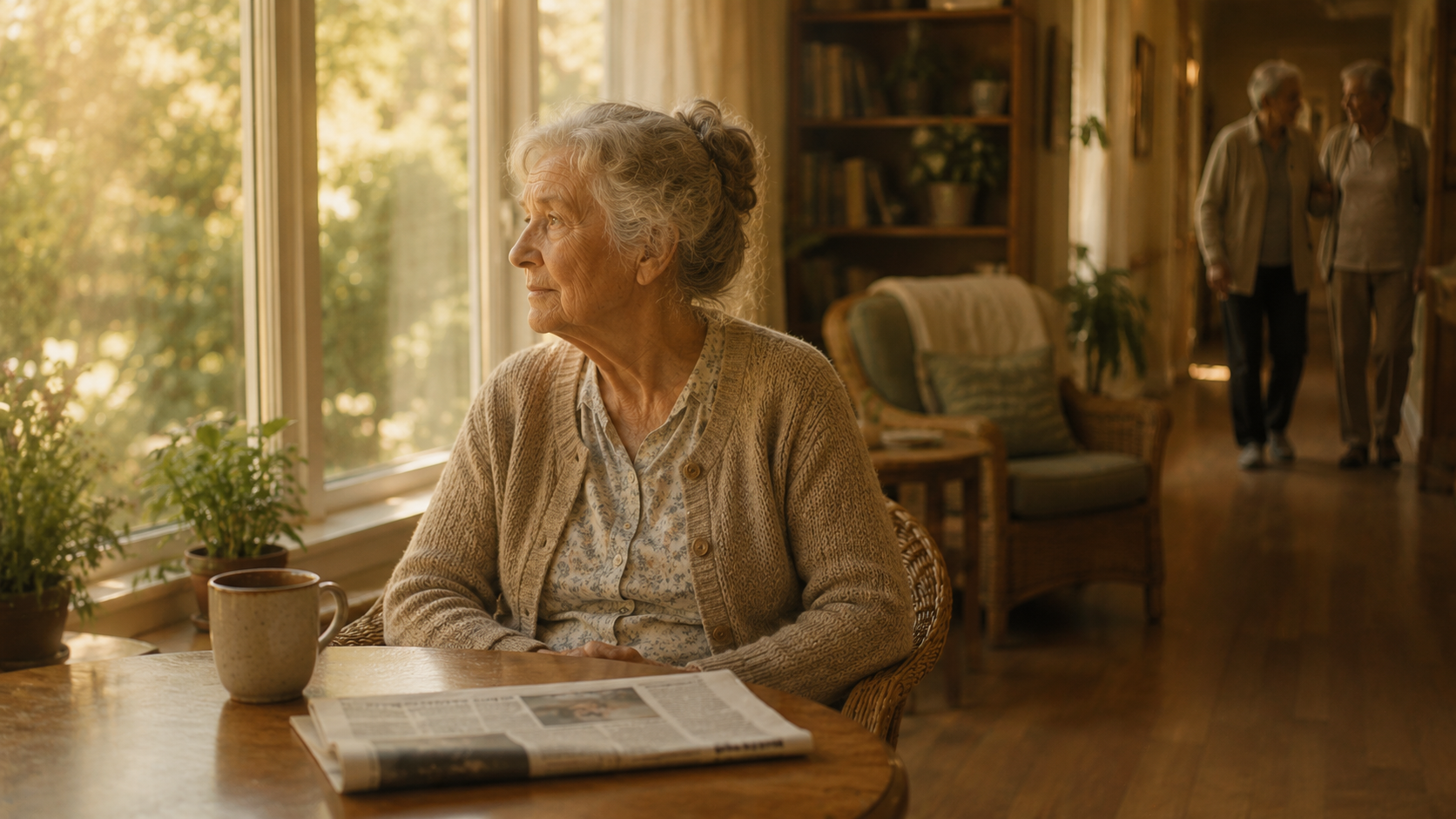
Louise was a crossword puzzle person. Every morning for years, she sat in the sunroom with a cup of coffee and worked through the daily puzzle from the newspaper. She was fast. She rarely needed to look anything up. The staff at her independent living community knew her routine the way they knew everyone's. Louise was in the sunroom. Louise was doing her crossword. Louise was fine.
Then Louise's daughter moved out of state. Her best friend in the community passed away in January. She stopped going to the dining room for breakfast. The crossword sat untouched most mornings. By March, Louise was spending most of the day in her apartment. By May, the care team was discussing a transition to assisted living.
The clinical notes described memory issues, difficulty with daily routines, confusion during conversations. All of that was true. But what nobody documented was the six months before the decline became visible, when the things that had kept Louise's brain active, connected, and stimulated quietly disappeared, one by one.
The brain is not a fixed system. It does not arrive at age 75 with a set capacity that simply runs down like a battery. It adapts. It compensates. It builds buffers against decline through a lifetime of experience, learning, and engagement. Neuroscientists call this cognitive reserve.
Cognitive reserve is the brain's accumulated capacity to maintain function even as pathology develops. A person with high cognitive reserve can sustain damage from aging, small vessel disease, or even early Alzheimer's pathology and still function well, because the brain has built enough redundancy and flexibility to work around the damage. A person with lower reserve reaches the threshold of visible decline sooner, even with the same amount of pathology.
This is not theoretical. It is one of the most well-established findings in aging research, and it explains something that clinicians have observed for decades: two people with nearly identical brain scans can present with very different levels of function. The difference is often reserve.
What builds cognitive reserve? Education. Occupational complexity. Social engagement. Cognitively stimulating activities. Physical exercise. The common thread is that the brain responds to sustained, meaningful demand by building stronger and more flexible neural networks. It is not about any single activity. It is about the cumulative effect of a life that keeps the brain working.
And here is what matters most for senior living communities: cognitive reserve is not fixed at move-in. It can be maintained, strengthened, and protected through the right kind of engagement. Or it can erode, quietly and quickly, when the activities, relationships, and routines that sustained it disappear.
The 2024 Lancet Commission on dementia prevention, intervention, and care identified 14 modifiable risk factors for dementia and estimated that addressing them could prevent or delay up to 45% of dementia cases worldwide. That number is up from 40% in the Commission's 2020 report. The list includes hypertension, hearing loss, smoking, diabetes, obesity, and physical inactivity. It also includes social isolation, which has remained on the list since the Commission first added it.
Social isolation is not a secondary concern on this list. It sits alongside the clinical conditions that every senior living community already screens for and builds care plans around. The difference is that communities have infrastructure for blood pressure, medication management, and fall prevention. Most do not have equivalent infrastructure for tracking whether a resident is socially connected, cognitively stimulated, or engaged in activities that sustain brain health in senior living communities.
A 2025 study by Kang et al., published in the journal Activities, Adaptation & Aging, found that combining social engagement with cognitive training produced stronger outcomes than cognitive training alone. Participants in the combined intervention showed greater improvements in cognitive function, and they reported that the social component, simply being around other people while doing the work, increased their motivation, consistency, and sense of wellbeing. The researchers noted that social interaction enhanced not just the experience of cognitive training, but its effectiveness.
This finding aligns with what life enrichment professionals have always understood intuitively: a group trivia game is not just trivia. A small discussion group is not just conversation. A collaborative art project is not just art. These activities combine cognitive demand, social engagement, and emotional connection simultaneously. They build and maintain cognitive reserve through multiple pathways at once, which is exactly what the research says works best.
A 2024 longitudinal study from the IDEAL cohort, published in Age and Ageing, found that cognitive reserve was associated with better cognitive function, better functional ability, and higher quality of life in people already diagnosed with dementia. Reserve did not prevent the diagnosis. But it preserved function longer and maintained quality of life further into the disease. For communities serving residents across the continuum of care, that finding has direct operational implications: the engagement a resident receives today influences how they function tomorrow, next month, and next year.
Cognitive reserve does not decline the way muscle mass does, gradually and predictably. It can erode suddenly when the inputs that sustained it are removed. A move to a new community. The loss of a spouse or close friend. A health event that disrupts daily routines. A pandemic that eliminates group programming for months.
Louise's story is not unusual. The crossword puzzle was not just a habit. It was daily cognitive stimulation, a structured demand on working memory, language processing, and retrieval. Her morning routine in the sunroom was social engagement, even if it looked like solitary activity, because it placed her in proximity to other residents and staff who engaged with her. Her friendship was emotional sustenance. Her daughter's regular visits were connection to identity and purpose.
When those inputs disappeared, Louise's brain did not simply "decline." It lost the sustained engagement that had been protecting it. The pathology that may have been developing quietly for years was no longer being buffered by reserve. The symptoms that emerged were real, but they were accelerated by the loss of the very things that had been keeping them at bay.
This pattern plays out in senior living communities every day. A resident loses a companion and withdraws. A resident moves from independent living to assisted living and loses the routines that kept them stimulated. A resident's favorite program gets cancelled and nothing replaces it. Each of these is a reduction in the cognitive, social, and emotional engagement that sustains reserve. And in most communities, none of it is tracked, documented, or visible to the care team making decisions about that resident's future.
The profession has never needed a research study to understand that engagement matters. Life enrichment professionals see the evidence every day. They see a resident who was withdrawing come back to life during a music program. They see a retired teacher light up when asked to lead a discussion. They see a resident with early-stage dementia participate in a structured word game with focus and confidence that surprises the clinical team.
What the research on cognitive reserve gives them is the language to explain why it works. A group game is not just fun. It exercises inhibition (waiting your turn), working memory (tracking the score), social cognition (reading the room), and sustained attention (staying engaged across rounds). A life story conversation is not just nice. It activates long-term memory retrieval, identity reinforcement, and emotional connection, three of the strongest contributors to maintained reserve.
The 6 Resident Engagement Intelligence Signals exist to capture exactly this kind of information at scale. Participation patterns reveal who is engaged and who is pulling away. Social signals track connection and isolation. Mood signals surface emotional changes over time. Behavioral signals reveal when a resident's actions are communicating something words are not. Life Story and Life Events give the context that makes every other signal meaningful.
When a community can see these signals together, the picture changes. A resident who stopped attending programs is not just "less active." She lost her companion in March and has no one left to go with. A resident whose mood signals are declining is not just "having a bad week." His daughter stopped visiting, and his daily crossword routine ended when his vision changed. These are not clinical events in the traditional sense. But they are events that directly affect cognitive reserve, and through it, independence.
The connection between engagement and independence is not abstract. It is operational. Communities make care transition decisions every day based on a resident's ability to manage daily routines, navigate social situations, make decisions, and maintain self-care. These capacities all depend on executive function. Executive function depends on cognitive reserve. And cognitive reserve depends, in part, on the sustained engagement a community provides.
This does not mean that engagement alone prevents care transitions. Cognitive decline has many causes, and some are beyond anyone's control. But it does mean that a community's engagement programming is not separate from its care outcomes. A community that provides rich, sustained, person-centered engagement is actively protecting the cognitive reserve of its residents. A community that offers a calendar of generic programming and counts attendance is not.
The distinction matters for resident engagement software as well. Systems that track only clinical data and attendance give care teams half the picture. Systems that also track engagement patterns, social connection, mood, and life events give them the full picture, including the early signals that a resident's reserve is eroding before the clinical symptoms become visible.
CMS has recognized the importance of this connection. F-Tag 679, updated in the State Operations Manual, requires that activity programs support the "physical, mental, and psychosocial well-being of each resident, encouraging both independence and interaction." The regulatory language already treats engagement as a contributor to independence, not just a quality-of-life amenity. The question is whether communities have the systems to know if they are meeting that standard for each individual resident.
There is a practical argument here that does not require altruism to understand. Residents who maintain independence longer generate more revenue for communities. They require less clinical staffing. They have higher satisfaction scores. Their families are more likely to refer others. The cost of a robust engagement program, including the technology to track its impact, is a fraction of the cost of a single premature care transition.
But the more important argument is simpler. Every resident who moves into a senior living community brings a lifetime of cognitive reserve with them. That reserve was built through decades of relationships, work, learning, hobbies, and daily routines. The community's job is not just to house that person safely and manage their medications. It is to sustain the engagement that protects what they have built.
Louise is still in independent living. The care team did not move forward with the transition. Instead, they looked at what had changed in her life, not just her clinical chart but her engagement patterns, her social connections, the routines she had lost. They introduced her to a small morning group that meets in the sunroom three days a week. A book discussion. Four women. Coffee.
She does not do the crossword anymore. But she is reading again. She is talking to people again. She is getting dressed in the morning because she has somewhere to be.
Nobody prescribed a medication for that. Somebody prescribed engagement. And it is working.