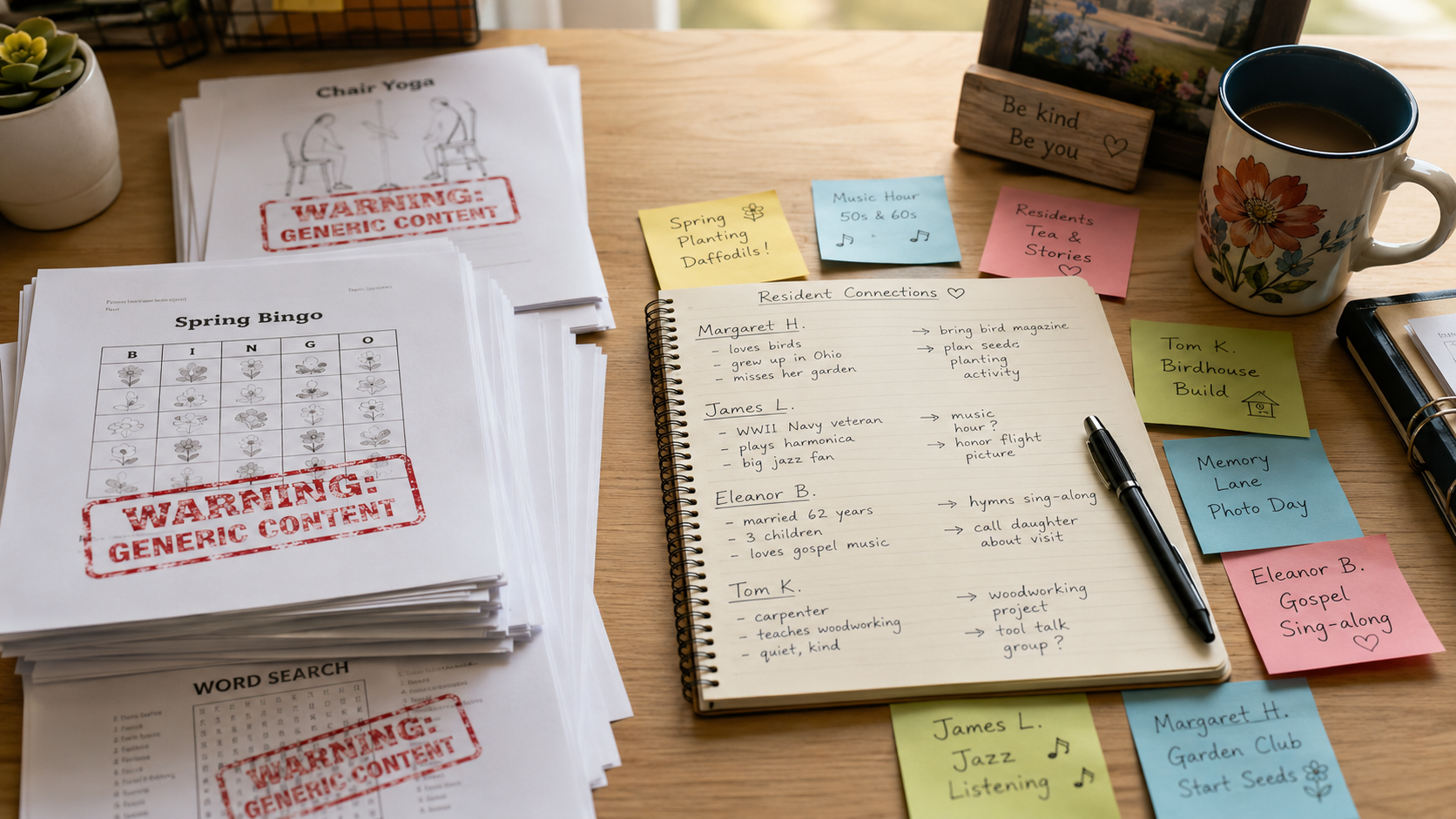
She opens her laptop at 6:15 AM, coffee still too hot to drink. She logs into the content provider's website hoping the new June library is available. Some of it is. Some of it still says "coming soon." She will have to check back later.
She scrolls through what is there. Three hundred "new" activities for June, more than half of them beach-themed. A new flag craft for Flag Day. Half a dozen other Flag Day activities that look familiar. A Father's Day lineup she could swear she has seen before.
None of it is wrong. But not much of it is right, either.
She thinks about Mr. Wallace, the retired wrestling coach who lights up during sporting events and competitions but will not attend anything before 10 AM and has no interest in crafts. She thinks about Mrs. Reeves, who lost her husband in April and has not come to a group program since. She thinks about the Wednesday afternoon group, where several residents have significant hearing loss and two get overwhelmed when the room has more than eight people.
Three hundred activities. Somewhere in there, something might work for someone. But not for the residents she is thinking about right now.
She closes the web browser tab and does what she always does. She builds a few things from scratch for the residents who need it most. The rest she fills with what she has, knowing most of it is not the right fit. But her executive director expects at least six programs a day, and she is running out of time.
Life enrichment content providers sell a simple promise: subscribe, and you will get fresh activity ideas delivered every month. Hundreds of them. Ready to use. All the planning done for you.
For activity professionals stretched thin on time and resources, it sounds ideal. And some of it is genuinely useful. A themed trivia set here. A printable game there. A holiday craft that fills a slot on a busy week.
But here is the problem nobody talks about.
Content providers market hundreds of fresh activities every month. Whether a small team can sustain that volume without revisiting their own archive is a question worth asking. But even if every activity were brand new, the fundamental problem would remain: none of them were written for your residents.
Some of it will connect. A beach trivia game might land perfectly for a group that loves the coast. A new Father's Day craft might genuinely work in a number of communities. But that connection is incidental, not intentional. And when you find yourself sorting through three hundred activities to find the twenty that actually fit your residents, the cost of the subscription becomes harder to justify. The editorial team behind that catalog is not building for your residents. They are building for everyone and hoping enough of it works for someone.
The provider does not know that Mr. Wallace coached wrestling for thirty years and loves anything competitive. They do not know that Mrs. Reeves lost her husband two months ago, or that the beach was their place together. They do not know that half their June library is a reminder, not an invitation. They cannot know these things. They have never set foot in your building.
You create life enrichment programming for the people you know. The content provider creates for a general audience and hopes for the best.
That is a fundamentally different model. And it matters more than this industry has been willing to admit.
The content provider model misunderstands something fundamental about life enrichment professionals. They are not waiting for someone to hand them ideas. They are skilled, creative practitioners who design experiences around the specific people in their care. They adapt on the fly. They notice who responded and who did not. They know the life stories and life events of their residents, and they use that knowledge to create programs that truly connect.
It was written by someone who has never met your residents.
The best programming has always come from the professionals inside the building. The ones who know the names, the histories, the small details that turn a generic activity into something that actually means something to the person in front of them.
That expertise is the most undervalued asset in senior living. And for too long, it has been locked inside individual buildings, individual notebooks, and individual heads with no way to share it.
Imagine a world where every activity professional who creates something meaningful can share it with every other professional doing the same work.
Not as a content provider. Not as a subscription service. As a community.
Imagine a retired music teacher in a memory care community in Ohio designs a rhythm-based recall program that her residents love. She shares it. An activity director in Texas adapts it for her Wednesday afternoon group and adds a modification for residents with hearing loss. She shares that version. A third professional in Oregon builds it into a six-week program arc for a resident who used to play drums in a blues band.
Thread by Quiltt was built around this exact belief. Thread's three Community Libraries (activities, events, and multi-session program arcs) are not content catalogs assembled by an editorial team. They are shared collections built by life enrichment professionals across the country. Every activity was designed by someone who knows their residents. Every program was built with real people in mind.
And the libraries grow every day.
The difference between a content provider and a community is structural.
A content provider has a ceiling: their editorial team. Even a talented team of twenty creators, working full time, produces content in a vacuum. They choose the themes from a conference room. They guess at what might work based on general demographics and seasonal calendars. They refresh and rotate their catalog to maintain the appearance of novelty, but the underlying library is finite. It only grows as fast as one team can produce.
The Community Libraries have no ceiling. They grow every time a professional creates something that works. They diversify every time someone in a different type of community, with a different resident population, contributes their approach. They deepen every time someone adapts an existing activity for a specific resident and shares the variation.
Over time, the value compounds. A content provider delivers roughly the same value next year as this year, minus whatever they recycle. A community-built library becomes richer, more diverse, and more practical with every professional who contributes.
A content subscription can give you a trivia game. It cannot give you a trivia game designed around the fact that 17 of your residents grew up in or around Savannah and remember the same corner drugstore, the same church picnic, and the same stretch of river where everyone spent their summers.
Savannah Stories was created in Thread in minutes, built for a community where residents share the same hometown. Corner drugstores, church picnics, summer afternoons on the river. No content provider could create this activity, because no content provider knows who is sitting in your building.
See the ActivityA content provider can give you a music program. It cannot give you a listening session built around the albums Mrs. Reeves and her husband used to play on Sunday mornings, the songs that might gently open a door that grief has closed.
Person-centered programming requires knowing the person. It requires their Life Story: personal history, identity, and the interests that define who they are. It requires awareness of their Life Events: the anniversaries, losses, and transitions that shape how they move through their days. It requires reading Mood and Behavioral signals to know whether today is a day for group energy or quiet, individual connection.
Thread was designed to amplify what you already know, not replace it. When you create a program arc in Thread, you are building something rooted in who your residents are. When you share it to the Community Libraries, you are giving other professionals a starting point they can adapt for their own residents. When you browse the libraries, you are drawing on the collective expertise of thousands of professionals who do the same work you do, for the same reasons.
That is the model. Not a provider handing down content from above. A community of professionals lifting each other up.
The life enrichment profession has been underserved by its tools for a long time. The assumption has been that what activity professionals need most is a steady supply of activities to fill a calendar. More content. More volume. As if the challenge were filling time slots, not reaching people.
That assumption was always wrong.
The professionals who show up every day, who know the residents by name, who adapt in real time because they can read the room in a way no content catalog ever could.
What the profession has needed is not more content. It is connection. A way for the thousands of skilled, dedicated activity professionals across the country to learn from each other, share what works, and build on each other's ideas.
Thread is that connection. The Community Libraries give professionals access to hundreds, and eventually thousands, of activities for seniors built by peers who know their residents by name. And Thread itself gives them the ability to create individualized programming for their own residents in minutes, not hours. Both get stronger as more professionals use them.
The community is greater than the provider. It always has been. Now there is a platform built to prove it.

The best programming comes from professionals who know their residents by name. Thread's Community Libraries put the collective creativity of life enrichment professionals across the country at your fingertips.
Start Your Free Trial