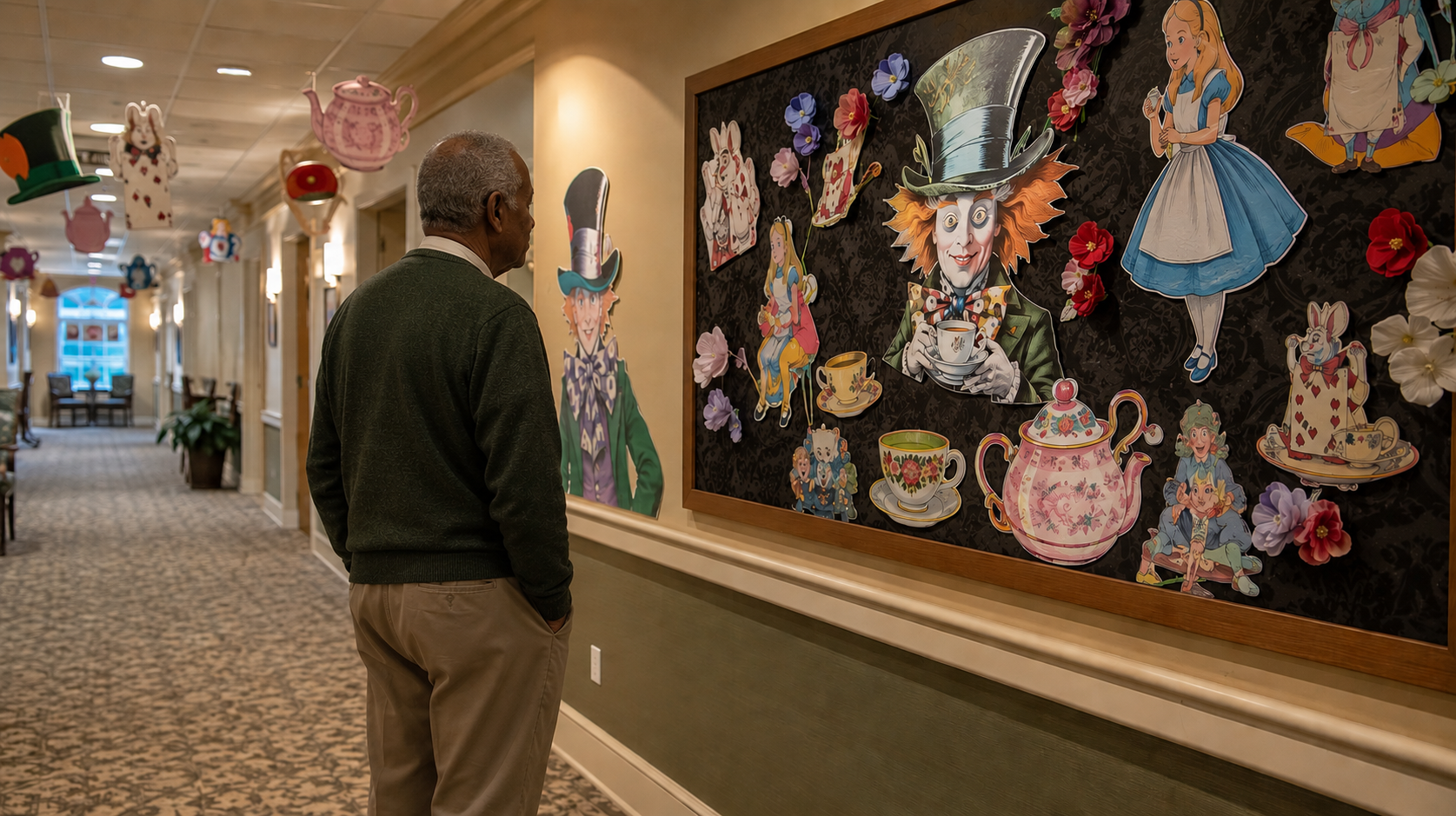
She had been an activity director for six years. Every month, new content arrived from the provider she subscribed to, and the majority of it was built around a theme. Alice in Wonderland. All About Babies. An entire month dedicated to a color. It came with clip art, decorations, word searches, trivia, lifelong learning activities, and more. There were a lot of activities offered, all tied to that central theme. She dove in, earmarked the ones she thought might work, and started planning.
She was good at it. Some residents attended the programs. Mostly the same group that always showed up. The calendar looked full. Leadership was happy.
But one afternoon, she sat with a resident named Harold who had been a blues musician for forty years. She asked him what he thought of the morning music program. He smiled politely. "It was fine," he said. "But nobody ever asks me what I'd want to listen to."
She looked at the calendar on the wall. Alice in Wonderland craft project. Alice in Wonderland group trivia. Alice in Wonderland tea party. Alice in Wonderland art project. Alice in Wonderland bingo. The bulletin board wrapped in an Alice in Wonderland border. Harold had spent three decades playing clubs in Chicago, and he idolized the great Buddy Guy. Nothing on the bulletin board had anything to do with him.
For more than twenty-five years, monthly themed content providers have been a staple of senior living life enrichment. They arrived at a time when the profession needed them. Activity directors were often working alone, stretched thin, and expected to fill a calendar with limited resources and almost no budget. Monthly themes gave them structure, ideas, and a starting point. For many, it was a lifeline.
They gave activity professionals something to build from when the alternative was starting from scratch every single month. Thousands of life enrichment teams across the country have relied on these resources, and the people behind them care about the work.
But the industry has changed. The conversation has changed. And the question worth asking now is whether the model that helped support this profession for so long is the same model that should define its future.
The monthly theme model has a structural problem that no amount of better content can solve: it places the calendar and the provider at the center of the engagement strategy, not the resident and the community.
When a community builds its month around Alice in Wonderland or All About Babies, the starting question is "what are we doing this month?" The question should be "who are we serving this month, and what do they need?"
Those are fundamentally different questions. And they lead to fundamentally different programming.
A themed calendar fills time. It creates a predictable rhythm. It gives staff something to point to when families ask what's happening this week. But when the theme is based on a children's novel from 1865, original content for a primary audience of 9 to 12-year-olds, it certainly does not start with Harold. It does not start with the woman who was a librarian for thirty years and would rather read poetry than do a baby-themed word search. It does not start with the veteran who lights up when someone asks about his service but has no interest in an Alice in Wonderland themed tea party for this month's community social.
And there is another question the industry has rarely asked: whose perspective do these themes reflect? The people creating monthly themed content are a small group making creative decisions for thousands of communities. Their choices, their interests, and their assumptions shape what millions of residents experience. Is a month about babies equally engaging for the men in the community? Does Alice in Wonderland resonate across cultural backgrounds? Is the team creating these themes as diverse as the communities they serve?
These are not accusations. They are honest questions about a model where a handful of people decide what an entire industry's residents will do for thirty days. Even with the best intentions, that is a narrow lens applied to an enormously diverse population.
Nobody planned for this to happen. The monthly theme model was not designed to undermine person-centered care. It was designed to help overwhelmed professionals fill a calendar. And for a long time, it worked well enough.
But "well enough" has a cost that compounds over time.
When an activity director spends most of their planning energy adapting a pre-packaged monthly theme to fit their community, they are spending that energy on logistics, not on resident engagement. They are figuring out how to make a color-themed month work for a memory care unit instead of asking what the people in that unit actually need this week. And that is before you even consider skill levels. Cognitive abilities vary dramatically between residents in memory care, yet most monthly themed memory care content is framed to support only the far end of the spectrum, leaving higher-functioning residents with programming that feels patronizing and lower-functioning residents with programming that still misses them entirely.
And the professionals who use these monthly themes know it. They have always known it. Most activity directors do not follow the content to the letter. They adapt, improvise, and supplement. They build their best programming around the people they know, not the theme that was provided to them in their monthly subscription. At best, the theme is a starting point.
But the starting point shapes where you end up. And when the starting point is always a theme chosen by someone who has never met your residents, the calendar will always look more like an activity schedule than a community and resident-centric engagement plan.
The senior living industry talks about person-centered care constantly. It appears in mission statements, marketing materials, social media posts, and regulatory standards. It is the vocabulary of modern senior living.
But person-centered programming requires knowing the person. Not just their name and room number. Their life story. Their career. Their passions. The music they love. The holidays that carry emotional weight. The loss they experienced before they moved in. The hobby that defined them for fifty years and that nobody in the building has ever asked about.
When life enrichment professionals have that knowledge, the programming they create is extraordinary. It is not painting Mad Hatter imagery to decorate the community. It is Harold leading An Afternoon with Buddy Guy blues listening hour because someone knew he played blues guitar in Chicago for three decades. It is a poetry circle built around a resident's favorite author because her life story is captured and visible to the whole team. It is a one-on-one visit with a veteran on the anniversary of his service because someone noticed the date and understood what it meant.
That is not a monthly theme applied to a building. That is person-centered engagement. And it is what every resident deserves.

An Afternoon with Buddy Guy was created in Thread in just a few minutes, built around one resident's lifelong love of Chicago blues. That is what person-centered programming looks like when the tools start with knowing the resident's life story.
See the ActivityLife enrichment professionals are not the problem. They have never been the problem. They are creative, empathetic, resourceful, and deeply committed to the people they serve. Many of them have been doing extraordinary person-centered work despite the tools they have been given, not because of them.
Thread by Quiltt was built for exactly this. Thread is an AI creative partner for life enrichment that helps activity professionals brainstorm, plan, and build comprehensive programming rooted in who their residents actually are. It does not send the same ideas to every community. It generates fresh, person-centered programming based on the interests, abilities, and stories of the real people in the building.
The monthly theme providers helped build this profession. That is real, and it matters. But the profession has outgrown the model. The conversation in senior living has moved away from packing a calendar with activities and toward finding opportunities for meaningful, person-centered engagement. It has moved toward resident engagement intelligence, toward systems that see the resident as a whole person. The tools that support life enrichment need to move with it.
The question this article is asking is not "were monthly themes bad?" They were not. They served a real purpose for a long time. They continue to be helpful for many communities. And the people behind them contributed meaningfully to a profession that needed support.
But the model asks a small group of people to decide what is engaging for an enormously diverse population of older adults. It asks one team's creative instincts to stand in for the preferences, histories, and identities of millions of unique individuals.
The question is: whose theme is it, anyway? Is it the content provider's? Or is it the resident's?
The answer should be obvious. And the tools should make it easy.

Your residents are not a theme. Thread helps life enrichment teams generate person-centered programming built around who their residents actually are, not what a content provider decided this month should be about.
Start Your Free Trial