Dorothy's name is third on the list when the care planning meeting gets to level-of-care transitions. Independent living, 83. The care team reads through recent notes. Dorothy has been interrupting other residents at meals. She made an inappropriate comment to a visitor last week that made more than a few jaws drop. She has been leaving the dining room mid-conversation, forgetting she was in the middle of talking to someone. She tried to walk into another resident's apartment twice on the same day because it "looked like hers."
James, the executive director asks the question everyone in the room is already thinking: is it time to talk about assisted living?
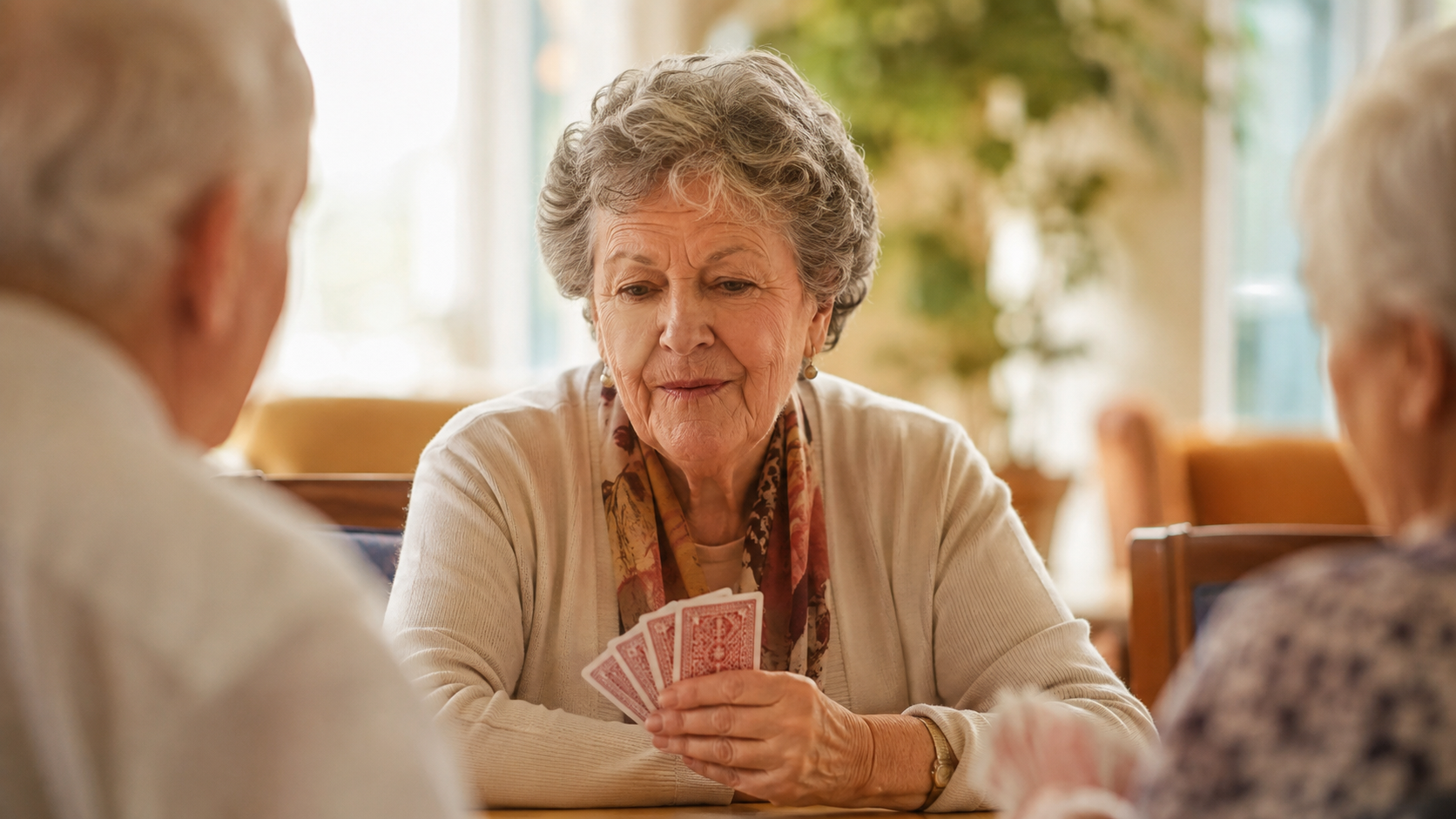
Dawn, the activity director speaks up. She has a different observation. Yesterday, in a structured word game, Dorothy waited her turn for 15 minutes. She held back answers to let a quieter resident go first. She caught herself about to say the wrong word, paused, and chose a better one. She stayed focused, engaged, and socially appropriate for the entire session.
Everyone at the table is quiet. They are describing the same person. But the Dorothy in the dining room and the Dorothy in the word game look like two different residents.
The difference is not willpower. It is not a good day versus a bad day. The difference is a single cognitive function that almost nobody on the care team can name.
Inhibition is one of the brain's core executive functions, and it governs more of daily life than most people realize.
It is what allows a person to pause before speaking. To filter out irrelevant information. To suppress an automatic response in favor of a more appropriate one. To stay focused on a conversation when the television is on across the room. To wait in line without becoming frustrated. To stop themselves from saying the first thing that comes to mind.
It sounds simple. It is not. Inhibition is the cognitive traffic controller that keeps everything else running. Without it, memory suffers because the brain cannot filter out distractions long enough to encode new information. Social interactions break down because the person cannot regulate what they say or how they respond to others. Decision-making becomes impulsive. Routine tasks that require sequencing, like getting dressed or preparing a meal, become unreliable.
When families and care teams discuss whether a resident needs a higher level of care, the conversation almost always centers on the same kinds of observations. She is saying things that are out of character. He is having trouble managing daily routines. She cannot stay focused long enough to take her medication correctly. He is getting frustrated more easily and walking away from situations he used to handle with patience.
These are not random symptoms. They are the predictable consequences of inhibition decline.
The instrumental activities of daily living (IADLs) that determine whether someone can live independently, things like managing medications, preparing meals, handling finances, and navigating social situations, all require intact executive function. Research from BMC Geriatrics has shown that specific executive functions, including inhibition, are directly predictive of functional decline in older adults. When inhibition weakens, the ability to perform these tasks independently weakens with it.
The pathway is consistent. A resident in independent living begins showing signs of disinhibition: impulsive comments, difficulty following group conversations, trouble filtering distractions, or behaviors that seem "out of character." The community responds by increasing support. When the support becomes continuous, the conversation turns to assisted living. In assisted living, if inhibition continues to decline, the same pattern accelerates. Social situations become more difficult. Self-regulation decreases. Wandering, agitation, or repetitive behaviors emerge. Memory care follows.
This is not a mystery. It is a sequence, and the sequence begins with the same function every time.
This is where the disconnect costs communities the most. Inhibition decline does not announce itself as a cognitive issue. It announces itself as a behavioral one.
A resident who interrupts others may be labeled as "difficult." A resident who makes inappropriate comments may be described as having "behavioral issues." A resident who cannot sit through a meal may be seen as restless or uncooperative. A resident who wanders into the wrong room gets flagged as a safety concern.
None of these labels are wrong, exactly. But none of them name the underlying cause. And when the cause goes unnamed, the response defaults to managing the behavior rather than supporting the function.
Alisa Tagg, a nationally recognized expert in life enrichment and behavioral health, has written extensively about this distinction. Her work reinforces that behavior is communication: every action has meaning, even when the individual cannot verbally express their needs. When staff understand the "why" behind behaviors, interventions become compassionate rather than restrictive.
The "why" behind many of these behaviors is inhibition.
This is not theoretical. The research base for cognitive interventions targeting inhibition in older adults continues to grow. Studies have demonstrated that structured cognitive training improves inhibitory control, with participants showing reduced error rates and improved response times. A 2021 study published in Dementia & Neuropsychologia found that inhibitory control training produced measurable improvements in both inhibition and cognitive flexibility in older adults.
But the most important finding for senior living communities is not that laboratory-based training works. It is that the kind of resident engagement life enrichment professionals already deliver exercises inhibition naturally.
A trivia game requires a resident to hold back an answer while another person speaks. A group discussion asks participants to listen, wait, and choose their words before responding. A card game demands strategic thinking: suppressing one move in favor of a better one. A collaborative art project requires following a sequence of steps and resisting the impulse to skip ahead.
These are not incidental benefits. They are the exact cognitive demands that keep inhibition strong. Dr. Rob Winningham, Professor of Psychological Sciences and Gerontology at Western Oregon University, has spent a large portion of his life researching memory and cognitive function in aging. His work emphasizes that exercising executive functioning, particularly the ability to pay attention and inhibit distractions, produces the strongest cognitive benefits for older adults.
The key insight is that the intervention does not need to feel like an intervention. A well-designed brain health game exercises inhibition in the same way a well-designed physical therapy session exercises balance. The resident experiences fun. The brain experiences a workout. And the function that determines whether that resident stays independent gets stronger instead of weaker.
Games by Quiltt is built on this principle. Every game in the library is designed in collaboration with Dr. Winningham to target specific cognitive functions, including inhibition, memory, attention, and processing speed. Games like Quick Spot, Word Color, Yarn Sort, Code Breaker, Jeopardy, and Wheel of Fortune are not entertainment dressed up as brain health. They are brain health interventions designed to feel like play.
When an administrator understands what inhibition is and how it declines, three things happen.
Care transition conversations change. Instead of asking "is this resident ready for assisted living?" the team starts asking "is this resident's inhibition declining, and are we doing anything to support it?" That question changes the timeline. It introduces the possibility that the right engagement, delivered consistently, could extend a resident's independence in measurable ways.
Activity programming gets clinical standing. When the executive director understands that a word game exercises the same cognitive function that clinical assessments measure when evaluating capacity for independent living, that word game is no longer a calendar filler. It is a cognitive prescription: a deliberate, person-centered intervention designed to support the function that keeps residents independent.
Behavioral observations become engagement intelligence. The activity director who notices that Dorothy functions well in structured engagement but struggles in unstructured social settings is seeing something clinically significant. That observation belongs in the care plan. It belongs in the conversation about Dorothy's future. And it belongs in a system that can track it over time, because a single observation is an anecdote, but a pattern of observations is Resident Engagement Intelligence.
The 6 Resident Engagement Intelligence Signals, Participation, Social, Mood, Life Story, Life Events, and Behavioral, exist to capture exactly this kind of information. When a resident's participation patterns change, when their social engagement declines, when their behavioral expressions communicate something their words cannot, those signals reveal what is happening beneath the surface. Inhibition decline is one of the things they reveal.
Dorothy is still in independent living. The care team did not move forward with the transition. Instead, they adjusted her engagement plan. More structured activities with clear social rules. A daily brain health game on her tablet. A small group discussion twice a week with a format that gives her something to focus on and a reason to filter her responses.
It is not a cure. Inhibition will continue to decline. But the rate of that decline is not fixed. It responds to engagement, to cognitive demand, to the kind of purposeful activity that life enrichment professionals deliver every day. The question is whether communities recognize that, resource it, and treat it as the clinical intervention it is.
Most communities are making care transition decisions based on the symptoms of inhibition decline without understanding the function itself. They are watching residents lose independence and responding with more support instead of more engagement. They are labeling cognitive decline as behavioral difficulty and missing the window where intervention could make a real difference.