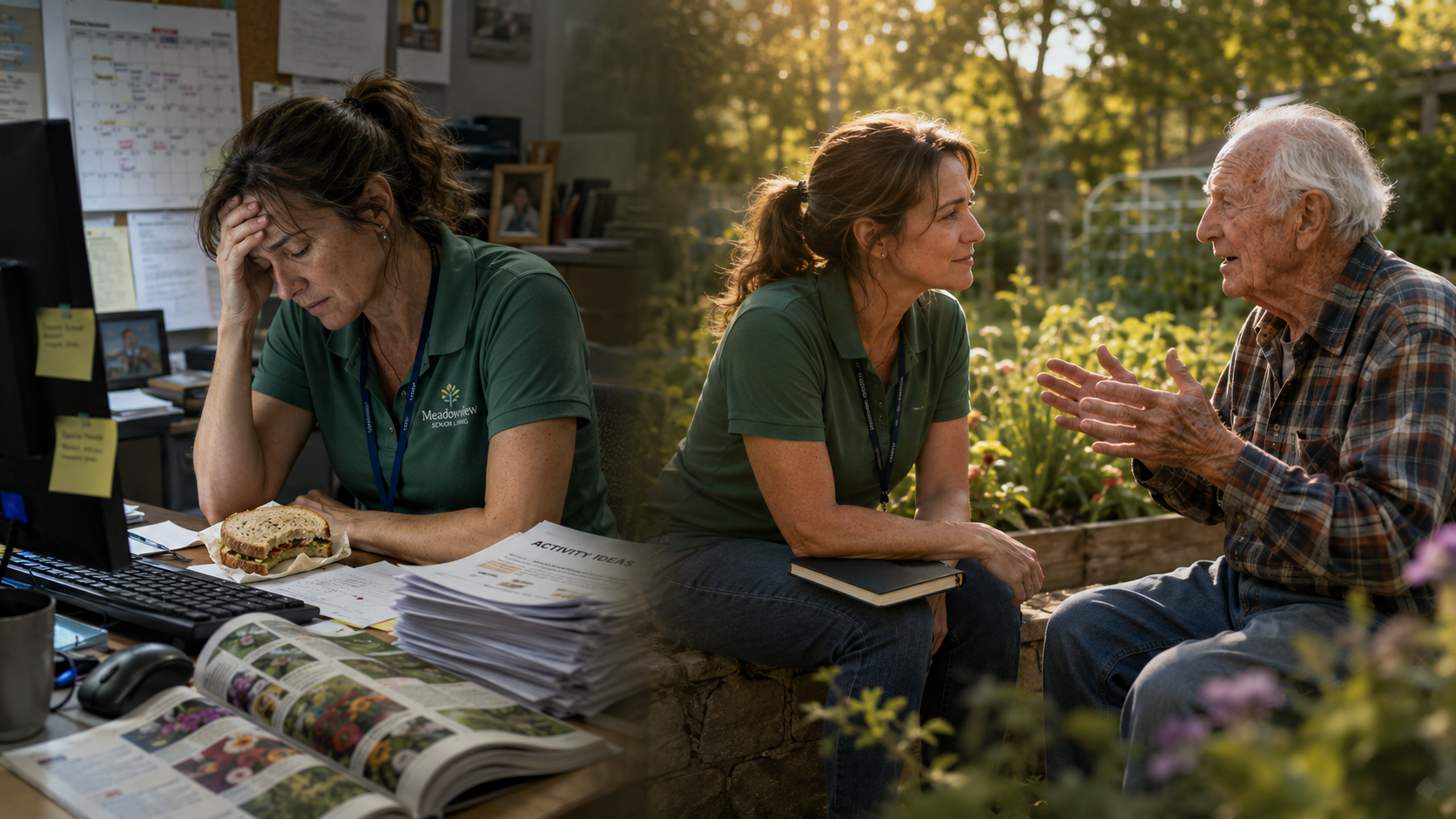
Two versions of the same Tuesday afternoon.
In the first, a life enrichment director is at her desk with three browser tabs open, a blank calendar template on her screen, and a half-eaten lunch pushed to the corner. She is searching for Fourth of July activity ideas, trying to find something she hasn't already done, formatting a newsletter no one on her team has time to proofread, and building a supply list for a craft project she found on Pinterest that looked promising but might be too complicated for her memory care residents. She has been at this desk since 7:30.
In the second, she is in the game room with a resident named Walter, learning that he spent thirty years restoring vintage motorcycles and that the sound of an engine still makes him sit up a little straighter. She is already thinking about three other residents who worked with their hands, and whether a small group built around restoration, repair, and craftsmanship might draw them into something more meaningful than the generic Tuesday afternoon Snack 'n Chat program she has been running on autopilot.
Both afternoons are part of her job. Only one is why she took it.
The phrase "less planning, more presence" resonates with nearly every activity professional who hears it. It resonates because it names something they already feel: the daily tug-of-war between the work they were called to do and the work that actually fills their hours.
Activity professionals did not enter this field to sit at a desk. Many came from healthcare, education, social services, or recreation backgrounds. They accepted the position because someone described a role centered on creating engaging programs and improving residents' lives. What they discovered is a role that also requires them to be event planners, transportation coordinators, volunteer managers, family liaisons, budget administrators, janitors in a pinch, newsletter editors, and documentation specialists, often all at once, often for ten or twelve hours a day.
Programs begin before breakfast and stretch into the evening. Special events mean arriving early, staying late, working weekends and holidays. Birthdays, anniversaries, family nights, and holiday gatherings do not wait for the staffing schedule. A single month of programming can require building a full calendar from scratch, sourcing ideas across multiple care levels, writing and formatting newsletters, preparing supply lists, coordinating with dining and nursing staff, creating signage, documenting attendance, and reporting outcomes. Multiply that across independent living, assisted living, and memory care, and the administrative workload becomes a second full-time job sitting on top of the one you were actually hired to do.
And the hardest part is that the planning itself is invisible. Families see the programming. Leadership sees the calendar. Nobody sees the hours it took to produce them. When budgets tighten, life enrichment is often among the first departments scrutinized. When outsiders describe the work, the phrase "you just play games all day" still surfaces, despite decades of professional advancement, certification, and evidence-based practice. The profession has been absorbing this quietly for years.
When a life enrichment professional is present with residents instead of behind a desk, something different happens. Not better planning. Better observation. And sometimes, outcomes that cannot be produced any other way.
The activity director in the game room with Walter is not wasting time. She is doing the most important part of her job. She is learning who he is. She is picking up on the details that no intake form captures: that his eyes light up when he talks about engines, that he leans forward when someone mentions building something, that he has been quieter since his wife stopped visiting as often.
These observations are the raw material of meaningful programming. They are also the source of the Resident Engagement Intelligence signals that make it possible to understand each resident as a whole person. The Life Story signal, the Mood signal, the Social signal: these do not come from a database. They come from a human being who was present enough to notice.
Every life enrichment professional can tell you about the moments that make this work matter. The isolated resident who found a real friendship through a shared-interest group. The family member who cried seeing her mother smile for the first time in weeks during a music program built around songs from her wedding. The resident in memory care who had stopped speaking but began talking again during a series of activities designed around something he used to love. These moments rarely make it into clinical documentation. But they change lives, and they only happen when someone has the time to design for them.
But presence requires time. And time is exactly what the planning burden takes away.
The problem is not that activity professionals plan too much. The problem is that the tools available to them have never made planning faster.
Not everyone starts from scratch. Tens of thousands of activity professionals subscribe to monthly content providers, and the best of them offer comprehensive, ready-to-go programming. These services have been the profession's most reliable resource for decades.
But the programming starts from the wrong place. It is designed by a small editorial team, built around a monthly theme that team selected, and shipped to thousands of communities at once. The content may be well-produced. It may be detailed, creative, and ready to execute. But it was not designed for your residents or your community. It was designed for every community, which means it was designed for no one's. And the bulk of what arrives each month is organized around a theme that has no connection to the people sitting in your dining room.
For the professionals who do start from scratch, the process is even more demanding: searching for ideas, adapting them across care levels, building a calendar, planning and shopping for events, formatting newsletters, preparing supply lists, documenting outcomes. Every step is manual. Every month begins from zero.
Either way, the planning burden persists. You cannot solve it by telling someone to plan less. The residents still need thoughtful, person-centered programming. Families still expect a full and varied calendar. Regulators still require documentation. The volume of work is the volume of work.
And the consequences of not solving it are real. Passionate, experienced professionals leave the field because they can no longer sustain the workload, the emotional demands, and the compensation that rarely reflects the complexity of their role. When they leave, communities lose the people who knew every resident by name, who understood which residents needed to be seated together at lunch and which ones needed someone to check on them after a bad night. Residents lose trusted relationships that took months to build. The profession loses expertise it cannot afford to keep losing.
Thread by Quiltt is the AI creative partner for life enrichment. It was not built to replace the professional. It was built to return the hours that planning has been stealing from presence. And it starts from the opposite place that content providers do. It does not start with a theme. It starts with a resident. For the first time, person-centered, individualized programming is not just a philosophy. It is something a life enrichment team can realistically execute every day.
Here is what that looks like in practice.
Activity ideas on demand, built around your residents. When you need a fresh idea, Thread generates one in seconds. Not a generic suggestion from a search engine, but an activity designed around the people you are planning for: their interests, their abilities, their stories. Found a YouTube video that would be perfect for your music reminiscence group? Give Thread the URL and it builds a full activity guide around that video, complete with discussion questions, adaptations for different ability levels, and follow-up content. When you are creating activities from scratch, Thread can also recommend YouTube videos that fit the experience you are designing.
Program Arcs that start from residents, not themes. Instead of picking a monthly theme and filling a calendar around it, you start from a person. Thread's Program Arcs take a starting point, a resident's interest, a life story detail, a conversation you had in the hallway, and build a multi-session series around it. Four types serve different purposes: Study arcs for sequential learning, Theme arcs for modular exploration, Series arcs for scheduled recurring events, and Practice arcs for progressive skill-building. Practice arcs carry particular weight because they ask a question most programming never considers: who does this resident still want to become?
A Community Library built by professionals like you. You are never starting from a blank page. Thread's Community Libraries contain activities, events, and full programs created and used by life enrichment professionals across the country. This is not a template library assembled by a content team. It is a living, growing collection of real programming, shared by the people doing the work, available to everyone using Thread.
The Daily Thread, ready before you are. Every morning, a two-page historical newspaper arrives with stories, facts, trivia, and games tied to the day. No prep required. Print it, hand it out, and start a conversation. It is the simplest version of what Thread does best: taking something that used to require time, or a costly subscription, and turning it into something that is just there when you need it.
When planning a person-centered program takes 30 minutes instead of three hours, the day feels different. The activity director who used to arrive early to format a newsletter now spends that time in the dining room, noticing who sits with whom and who eats alone. The director who used to spend her lunch hour searching for craft ideas now eats with residents and hears about Walter's motorcycles.
These are not small differences. They are the difference between a professional who is surviving the role and one who is thriving in it. Between a community where programming is reactive and one where programming is personal. Between a profession that keeps burning out its best people and one that protects them.
Activity professionals chose this work because they believe in what engagement does for people. They believe that a good afternoon matters. That a meaningful conversation can change someone's week. That the right activity at the right time for the right person is a form of care that nothing else in the building replaces.
In other words, they believe engagement is care.
The profession does not need more hours. It needs tools that respect how those hours should be spent. Thread was built around one conviction: that the real work of life enrichment happens in the community with the residents, not at the desk with the calendar.
Less planning. More presence. That is not a tagline. It is what the profession gets back when planning finally takes less time.

Thread is the AI creative partner for life enrichment. Start your free trial and see what your afternoons look like with less planning and more time in the room.
Start Your Free Trial